5. Climate Change
5. Climate Change
-
5.1.1 Evidence of climate change: global temperature data, ice cores, sea ice positions, historic writing and paintings.
5.1.2 Factors influencing natural climate change: orbital changes (Milankovitch cycles), sunspots, volcanic activity.
5.1.3 The human influence on the atmosphere causing the enhanced greenhouse effect. For example, the use of fossil fuels, deforestation, agriculture.
-
5.2.1 The present day and predicted future impacts of climate change. For example, rising sea levels, and changes to global temperature, weather patterns, and food production.
-
5.3.1 The strategies (including national and international agreements) and techniques used to manage the impacts of climate change.
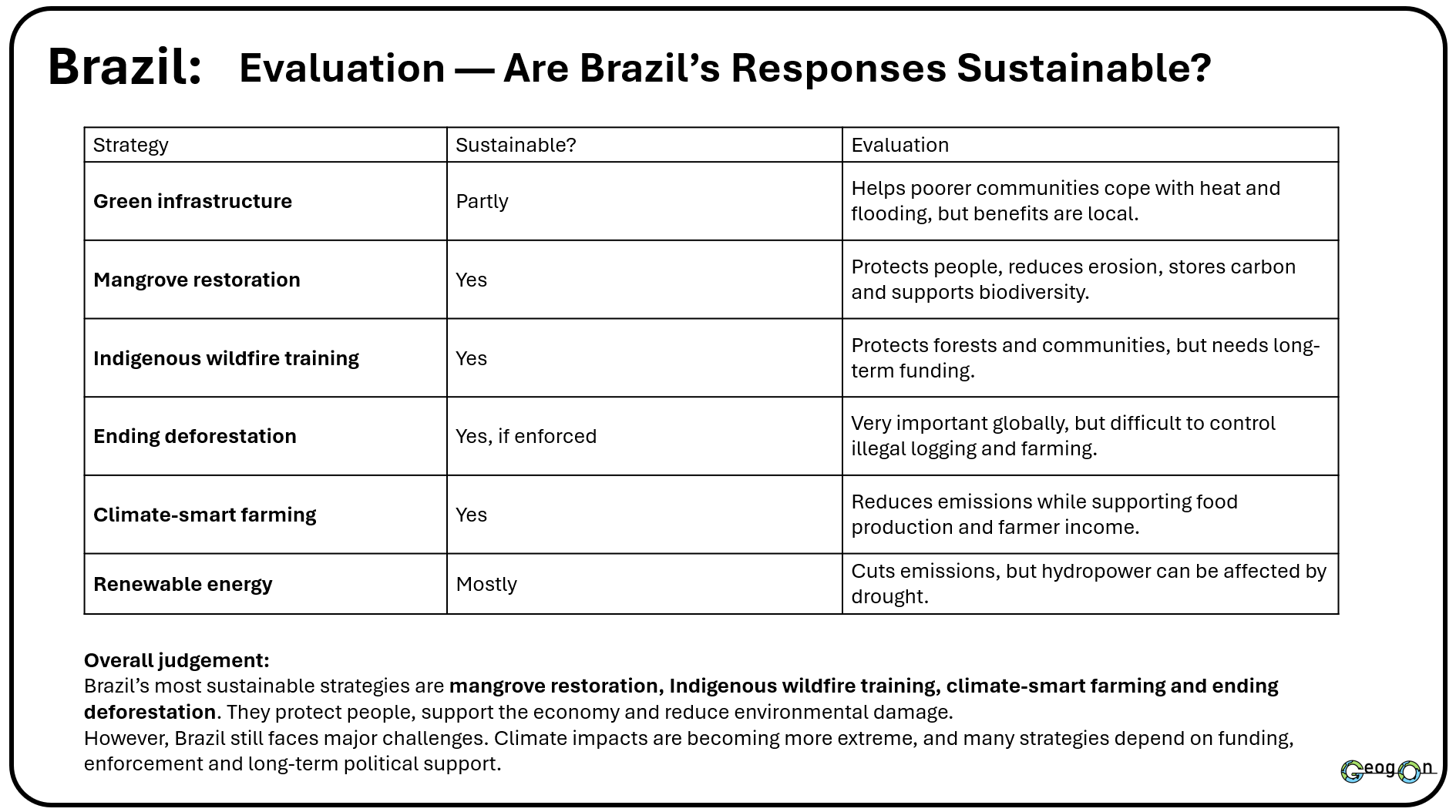
5.3.2 An evaluation of mitigation (including international agreements) and adaptation strategies and techniques used to manage the impacts of climate change.
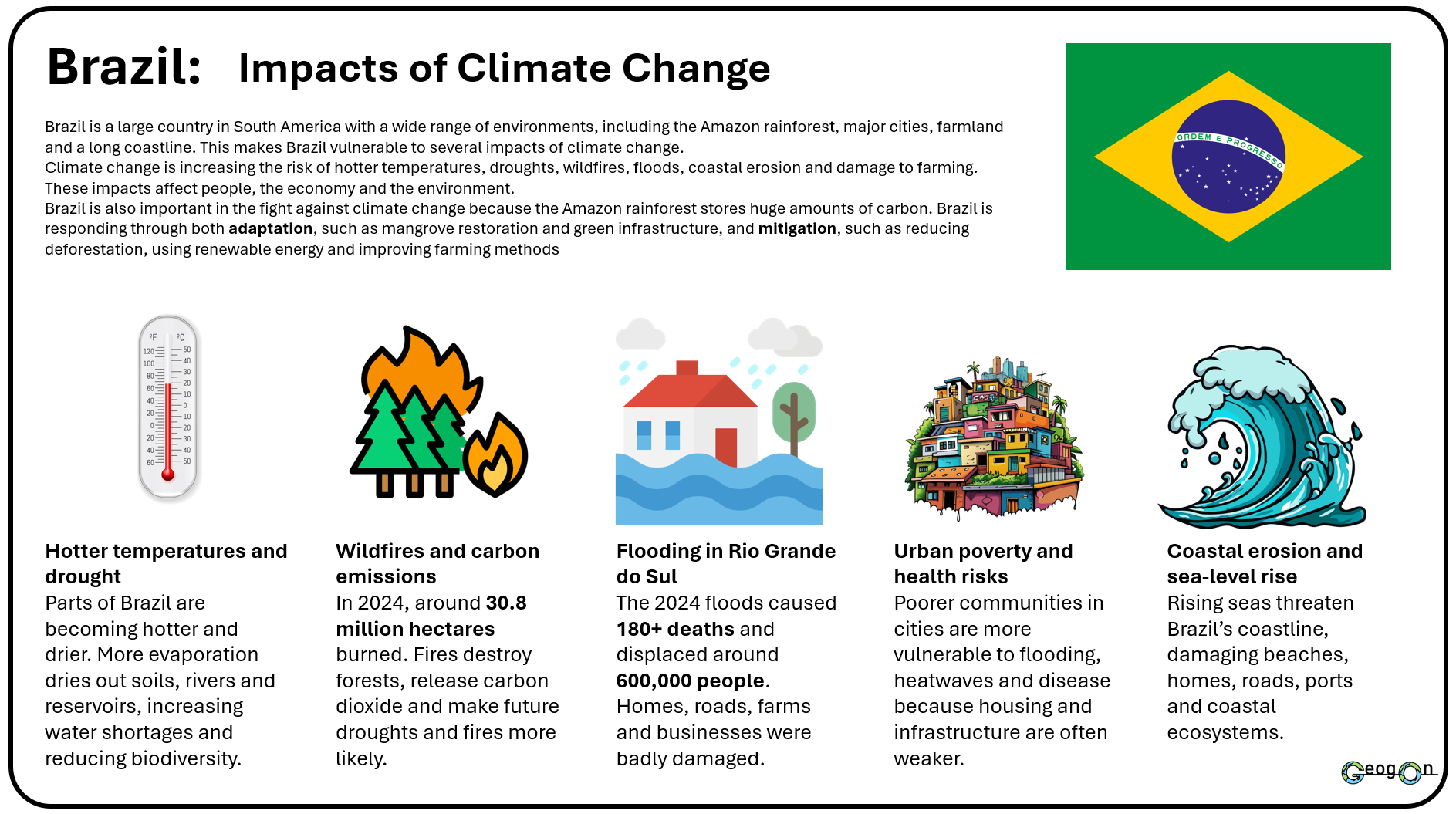
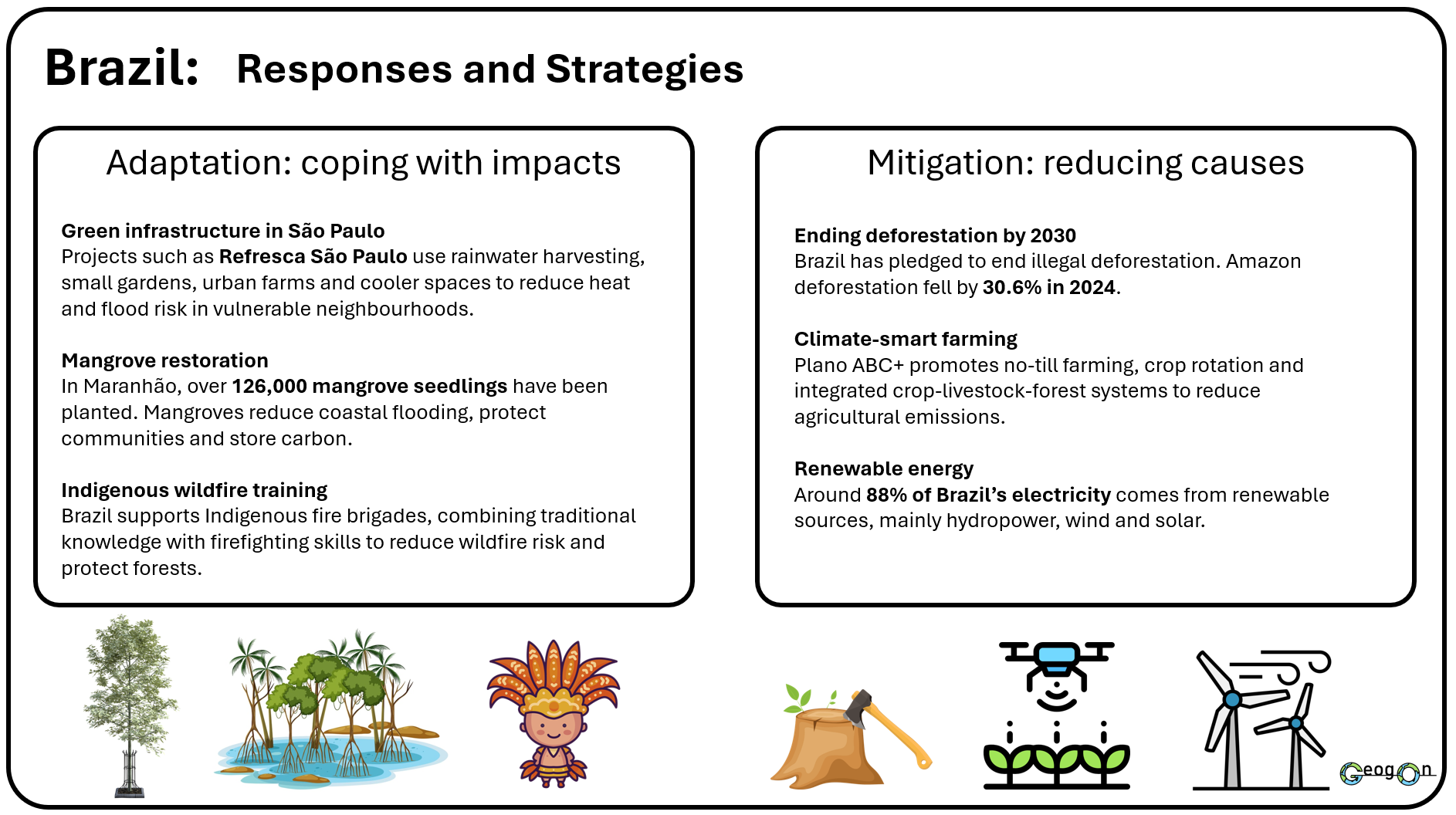
5.3.3 One detailed specific example of a named country or region to include:
• the impacts of climate change
• the responses to climate change
• the strategies and techniques being used to manage climate change; including sustainable.
5.1 The natural and human causes of climate change
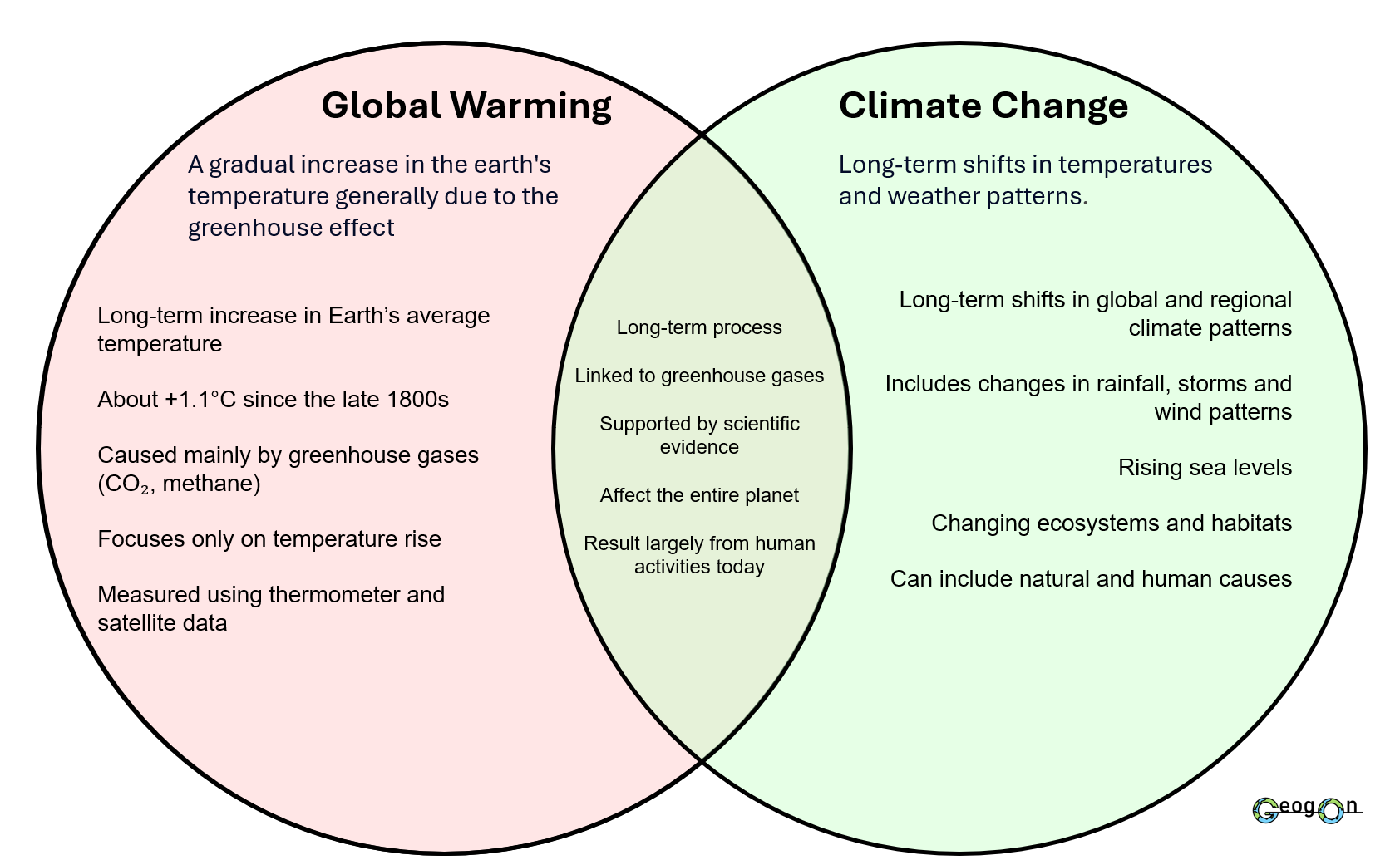
The difference between climate change and global warming
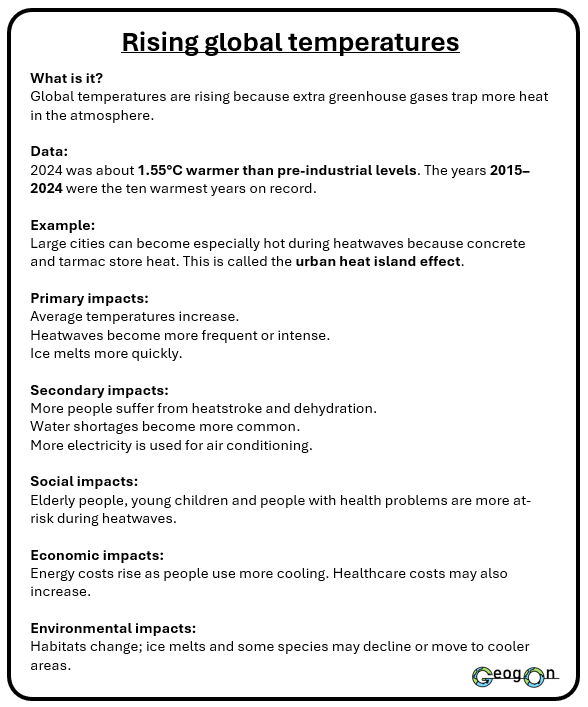
Climate change means long-term changes in the Earth’s average weather conditions, including temperature, rainfall, storms, sea level and ice cover. These changes can happen naturally, but recent climate change is mainly linked to human activities.
Global warming is the rise in the Earth’s average temperature. It is one part of climate change.
The difference is simple: global warming is about temperature rising, while climate change includes all the wider effects of that warming, such as melting ice, rising sea levels, changing rainfall patterns and more extreme weather.
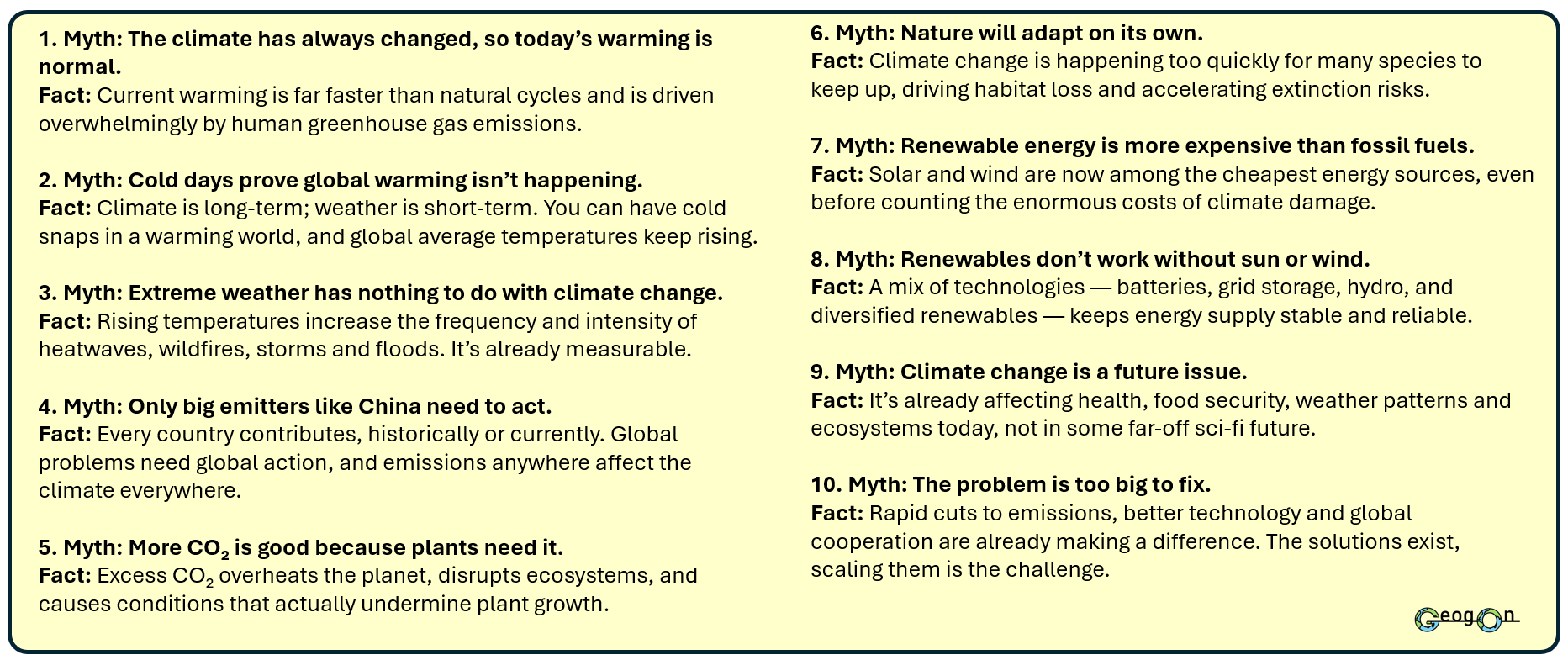
Climate Myths
5.1.1 Evidence of climate change
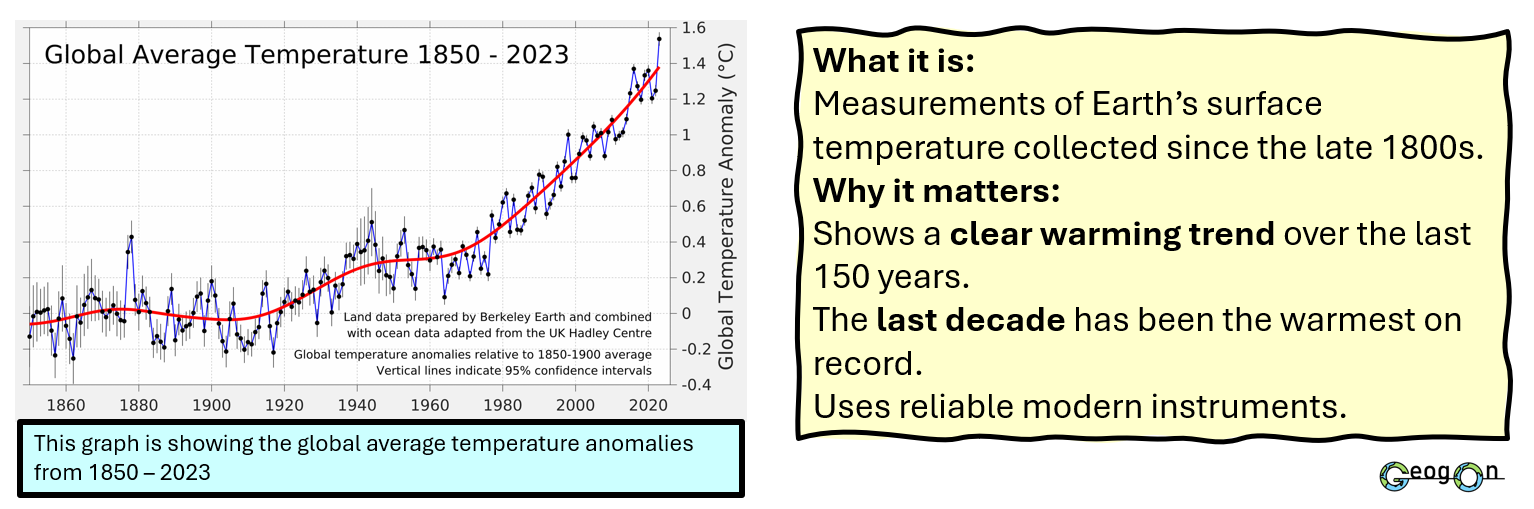
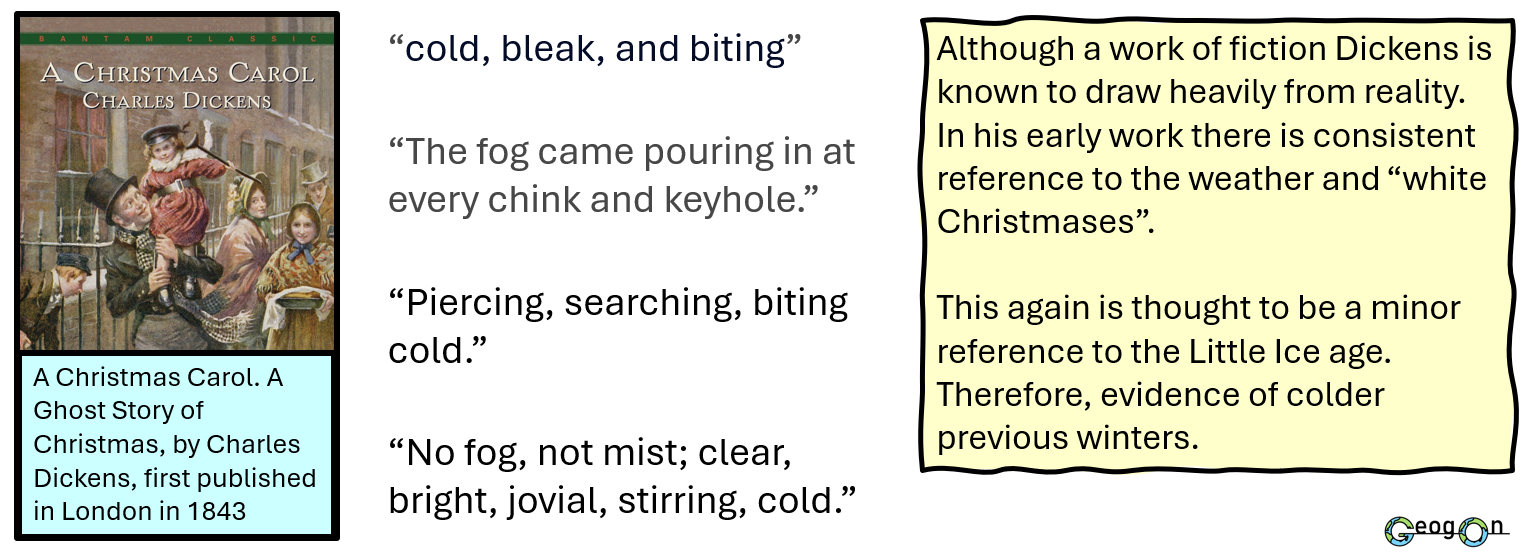
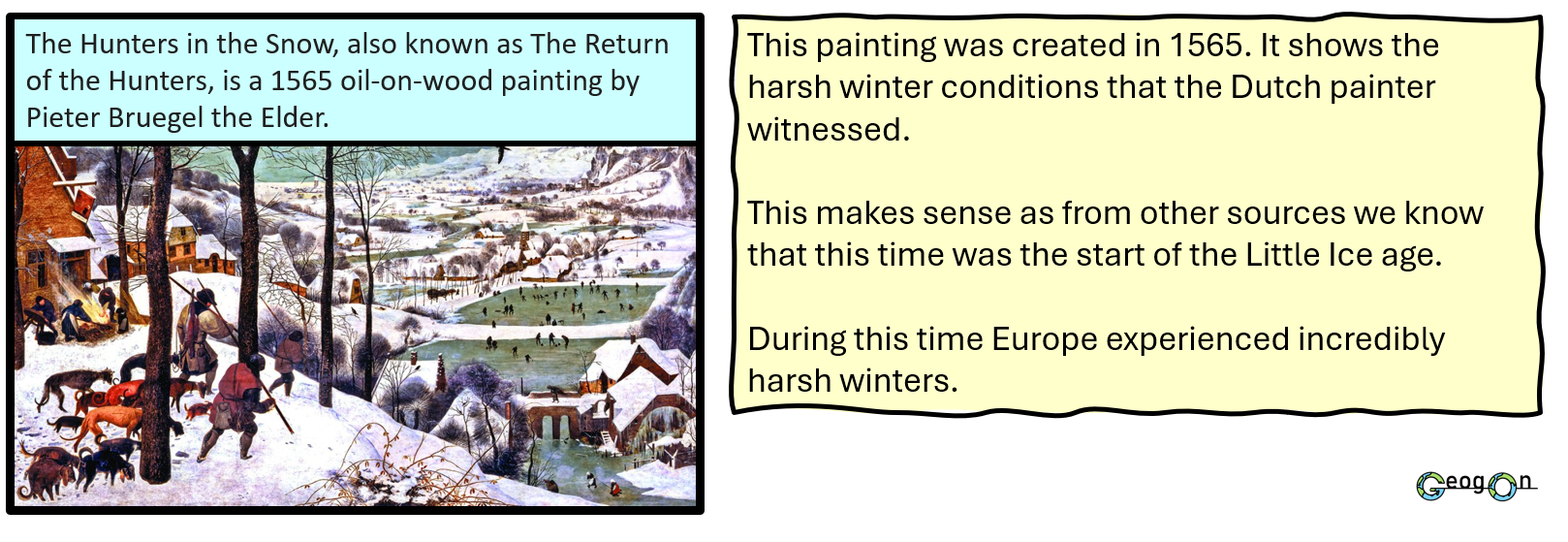
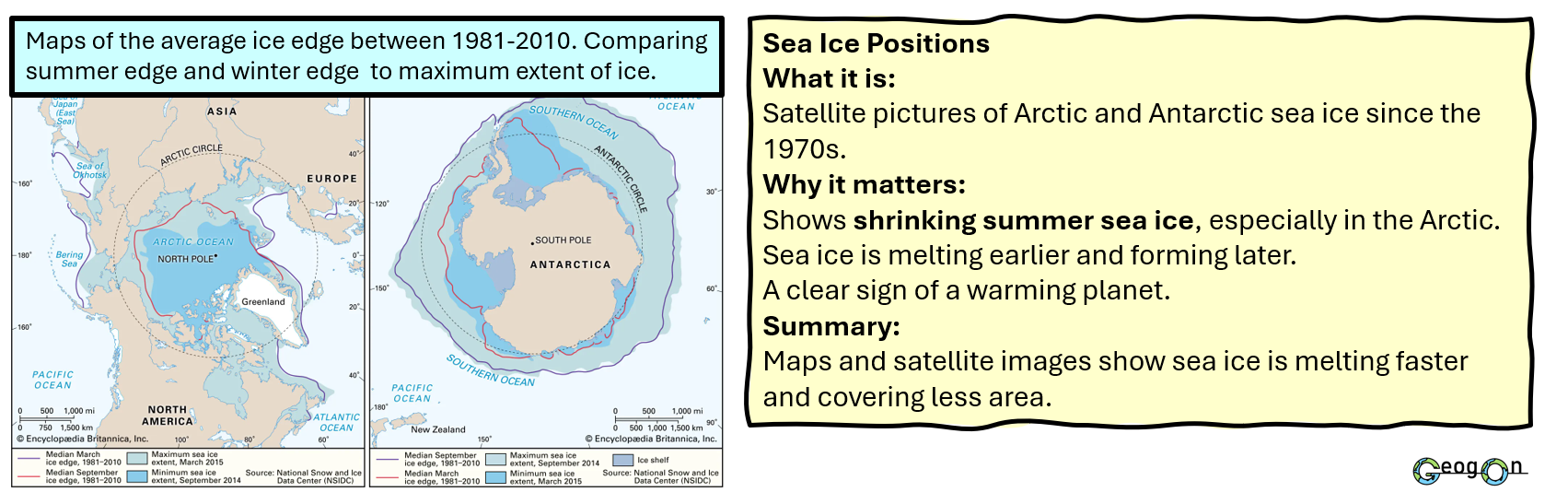
Scientists use different types of evidence to show that the Earth’s climate has changed over time. Some evidence comes from modern measurements, such as global temperature records and satellite images of sea ice. Other evidence comes from the past, such as ice cores, historic writing and paintings. Together, these sources help us understand how climate has changed in the past and how quickly it is changing today.
Evidence of Climate Change
-
![]()
Global Temperature Data
-
![]()
Historic Writing
-
![]()
Historic Paintings
-
![]()
Sea Ice Positions
-
![]()
Ice Cores
Ice Cores
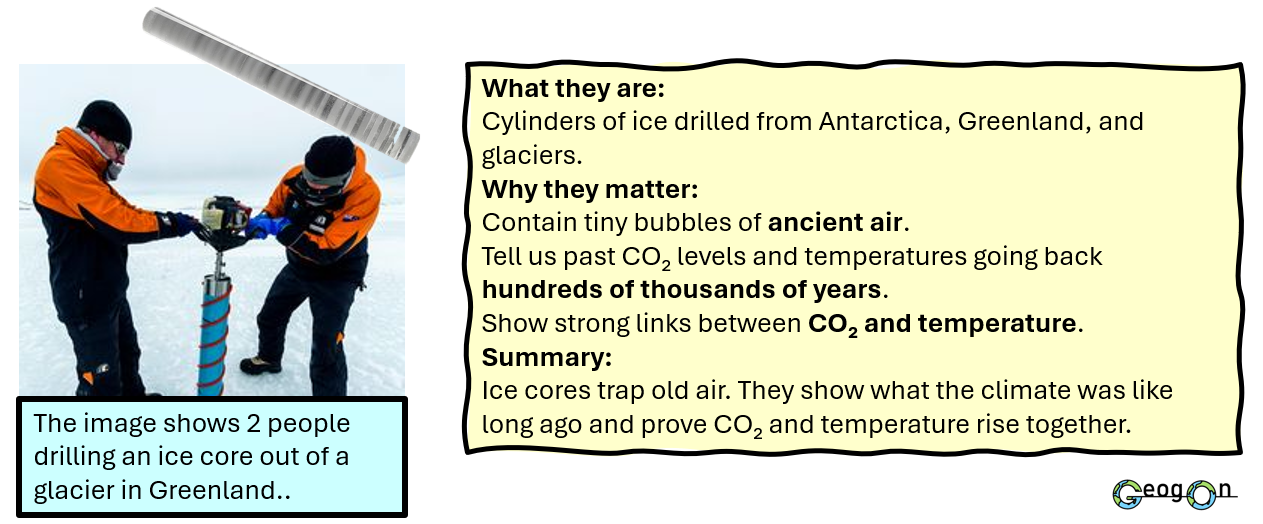
Ice cores are long cylinders of ice drilled from ice sheets and glaciers, especially in places such as Antarctica and Greenland. They are useful evidence for climate change because they contain information about the Earth’s past climate.
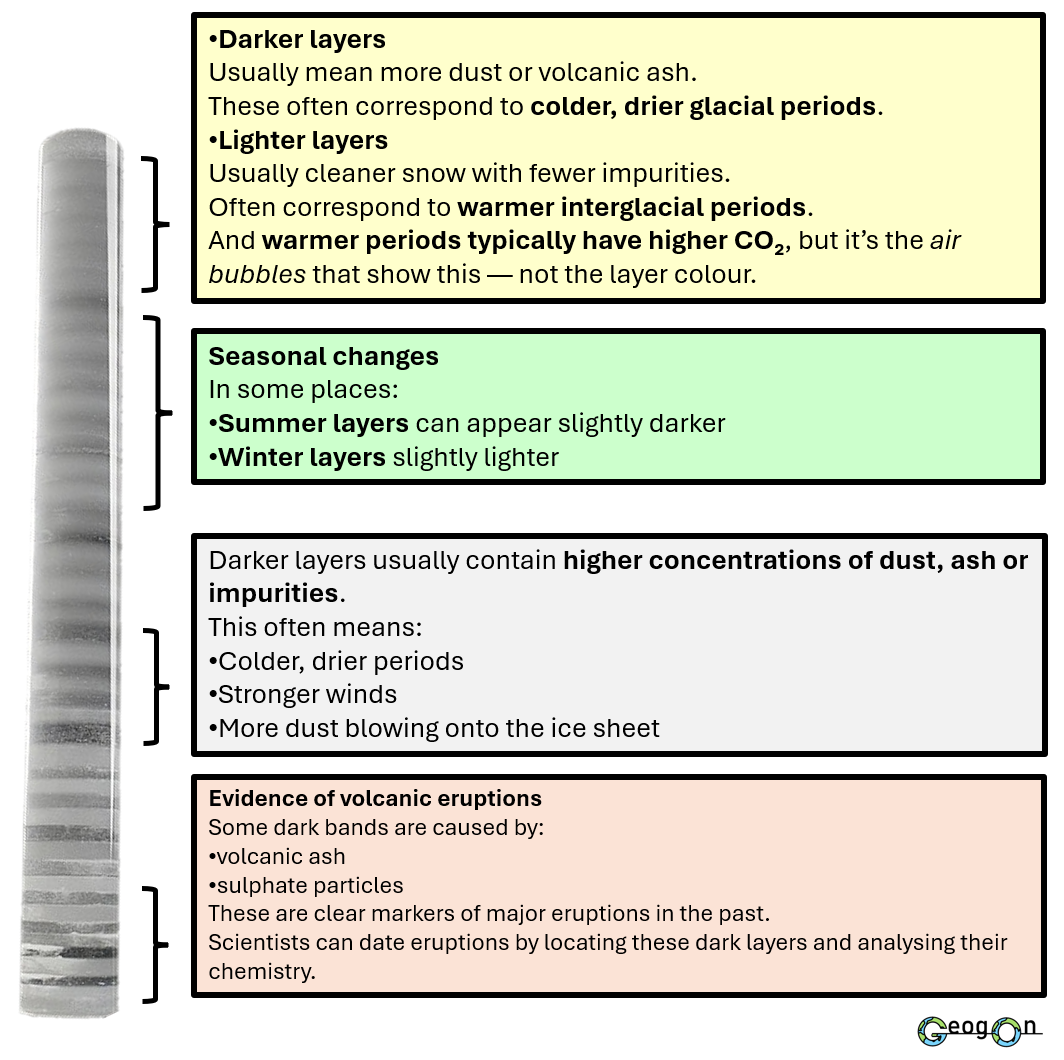
Each year, snow falls and is slowly compressed into layers of ice. These layers build up over thousands of years. Scientists can study the layers in a similar way to tree rings, with deeper ice usually being older.
Tiny bubbles of air become trapped inside the ice. These bubbles contain samples of the atmosphere from the past. By studying them, scientists can find out how much carbon dioxide and methane was in the atmosphere at different times. These are important greenhouse gases.
Ice cores can also help scientists estimate past temperatures. The chemicals in the ice, especially different forms of oxygen, can give clues about whether the climate was warmer or colder when the snow originally fell.
Ice cores show that the Earth’s climate has changed many times in the past, with colder glacial periods and warmer interglacial periods. They also show a close link between greenhouse gas levels and temperature. When carbon dioxide levels were higher, temperatures were usually higher too.
This makes ice cores strong evidence for climate change because they allow scientists to compare past climate change with the rapid warming happening today.
Natural vs Enhanced Greenhouse Effect
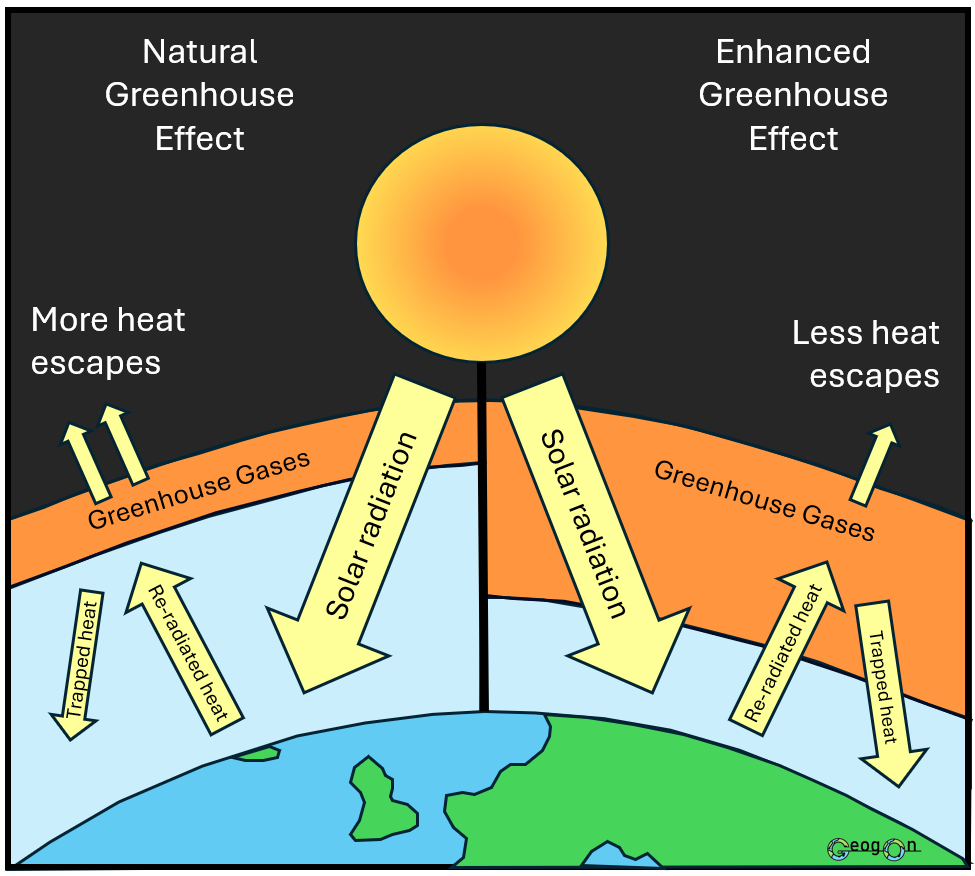
The natural greenhouse effect is the process that keeps the Earth warm enough for life. Energy from the Sun reaches the Earth as short-wave radiation. Some energy is reflected back into space, but some is absorbed by the Earth’s surface. The Earth then releases this energy as long-wave heat radiation. Greenhouse gases, such as carbon dioxide, methane and water vapour, trap some of this heat and send it back towards the Earth.
Without the natural greenhouse effect, Earth would be too cold for most life, with an average temperature of around -18°C.
The enhanced greenhouse effect happens when human activities add extra greenhouse gases to the atmosphere. These extra gases trap more heat than normal, so less heat escapes into space. This causes the Earth’s average temperature to rise, leading to global warming and wider climate change.
The enhanced greenhouse effect is mainly caused by:
burning fossil fuels, which releases carbon dioxide
deforestation, which reduces the number of trees removing carbon dioxide
agriculture, especially cattle farming, which releases methane
landfill sites and waste, which also release methane
fertilisers and some industrial processes, which release nitrous oxide
The key difference is that the natural greenhouse effect is essential for life, while the enhanced greenhouse effect is caused by human activity and is making the planet warmer than normal.
5.1.2 Factors influencing natural climate change
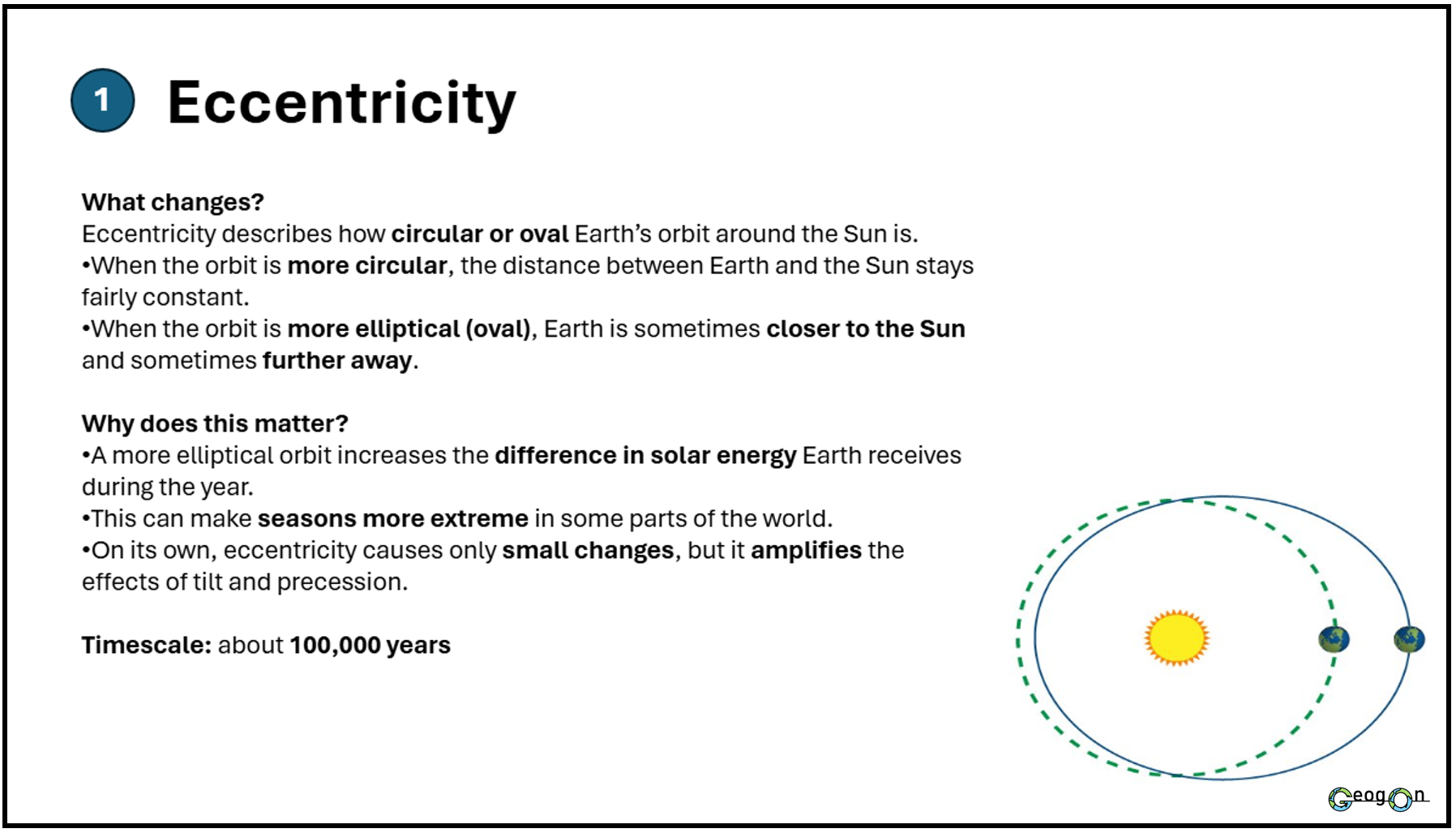
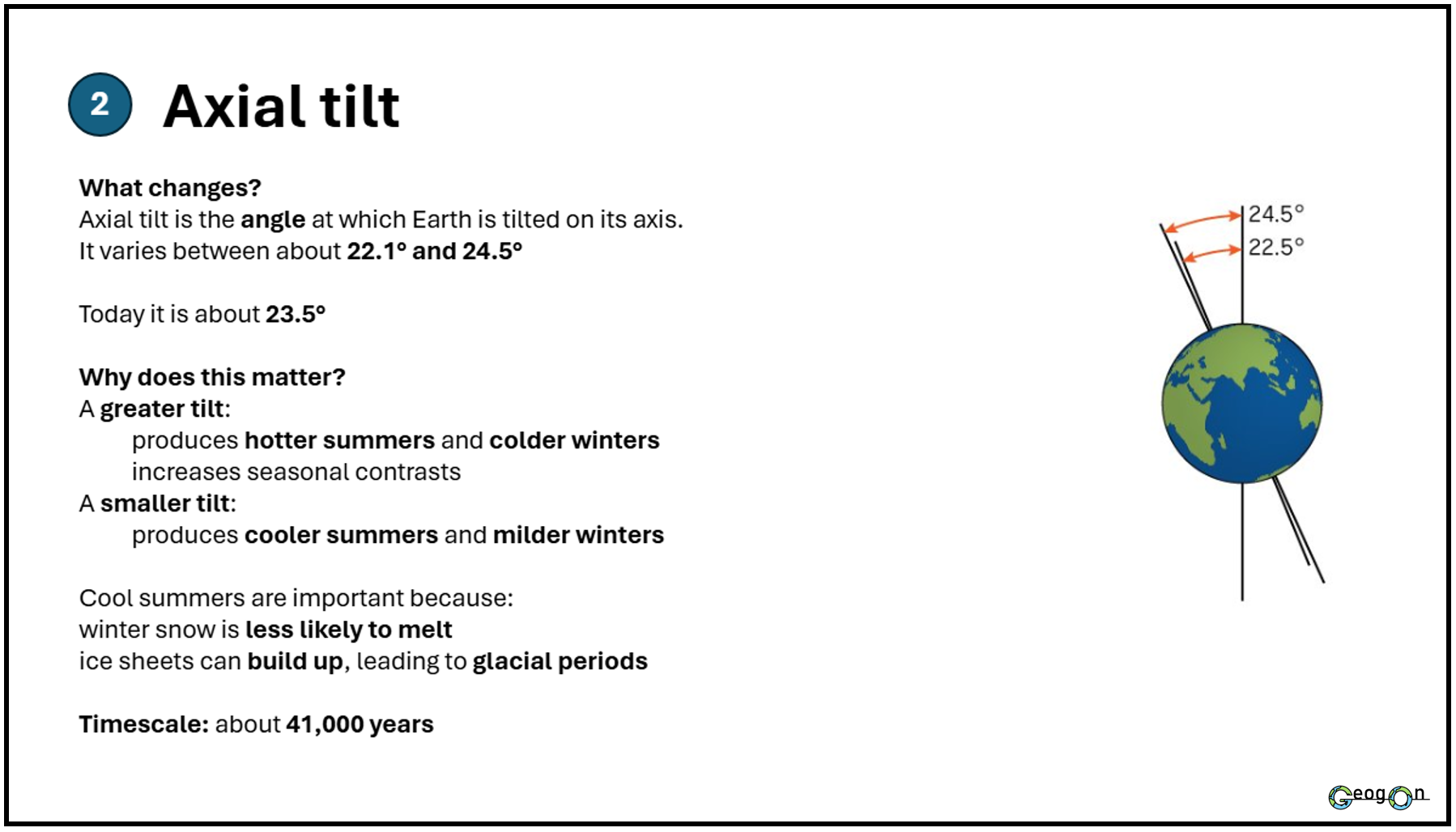
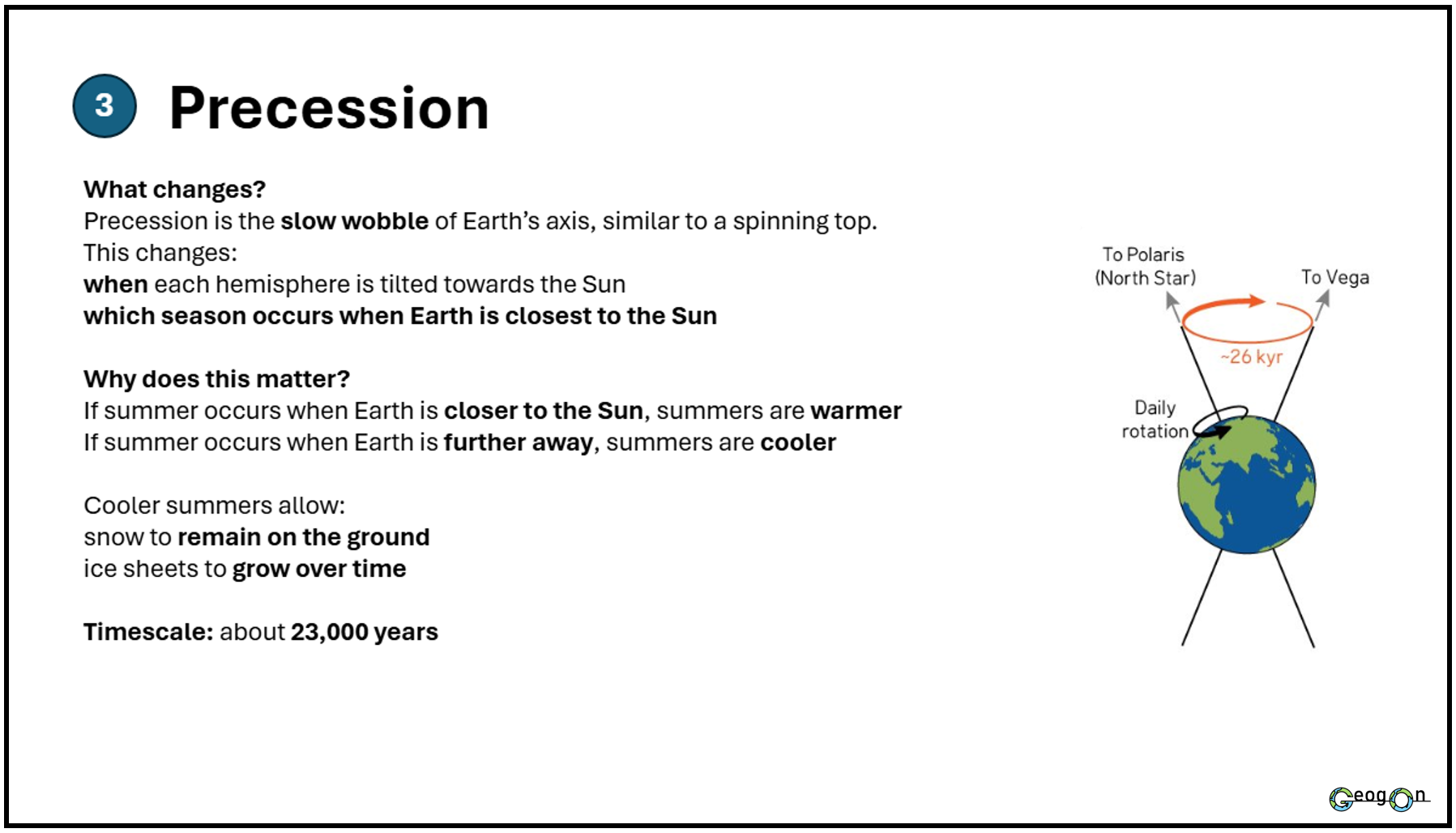
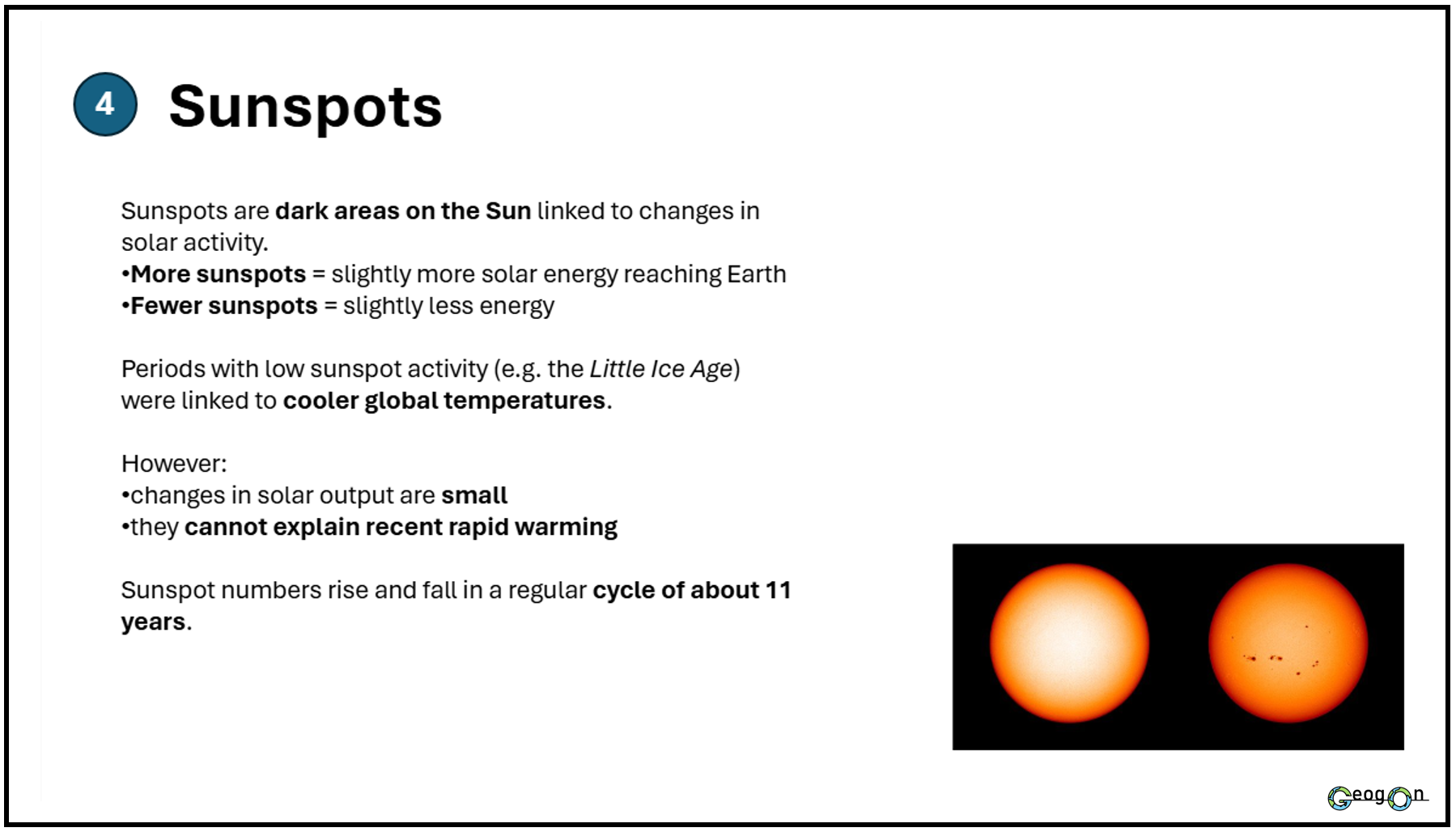
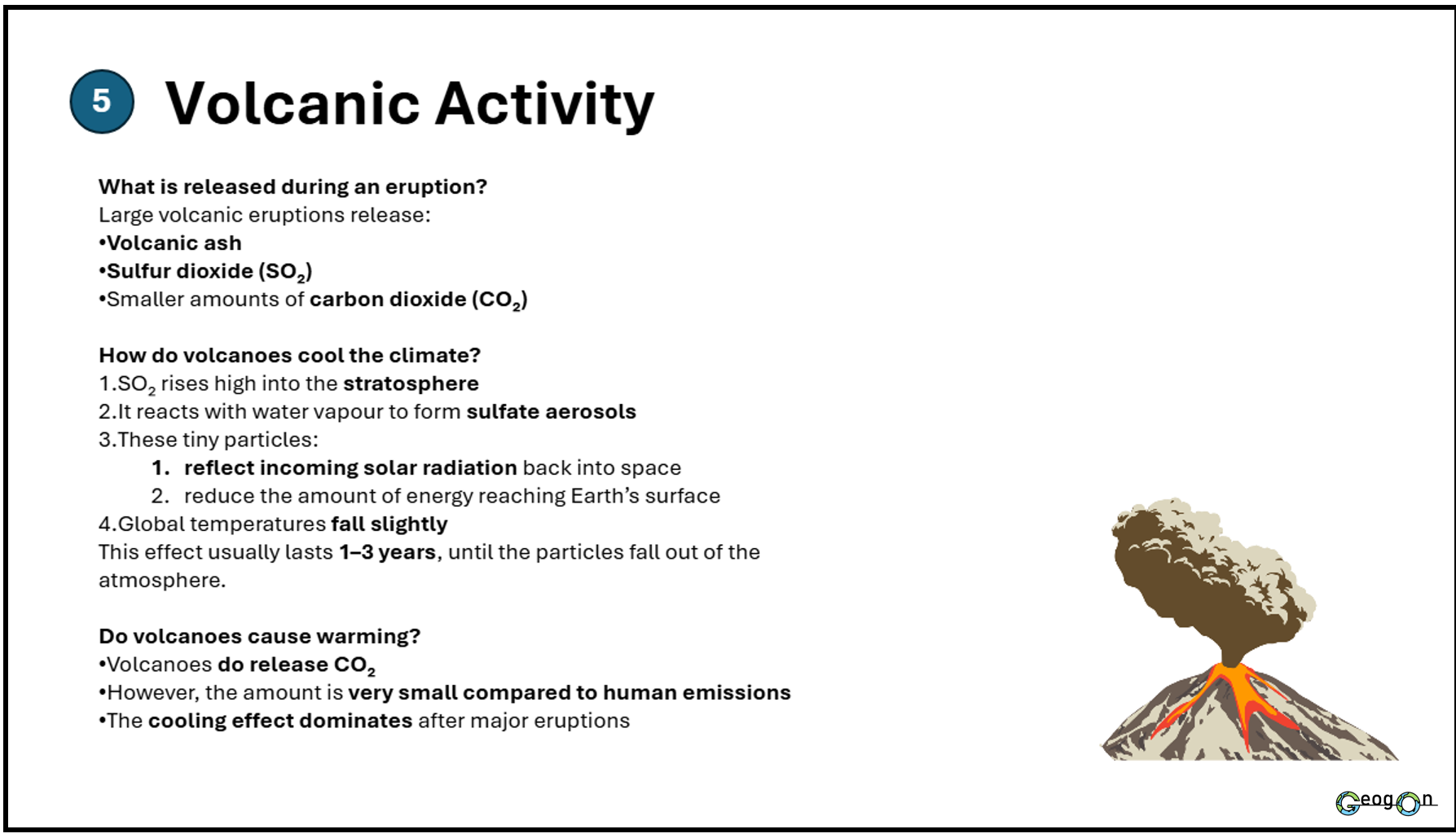
Climate has changed naturally throughout Earth’s history. Long before humans burned large amounts of fossil fuels, the Earth experienced colder periods called glacials and warmer periods called interglacials. Natural climate change can be caused by changes in the Earth’s orbit (Milankovitch cycles), changes in solar activity and volcanic eruptions.
Factors Influencing Natural Climate Change
5.1.3 The human influence on the greenhouse effect
Human activities are increasing the amount of greenhouse gases in the atmosphere. This strengthens the natural greenhouse effect and causes the enhanced greenhouse effect.
The Sun’s energy reaches Earth as short-wave radiation. The Earth absorbs this energy and then releases heat as long-wave radiation. Greenhouse gases such as carbon dioxide, methane and nitrous oxide trap some of this heat. When humans add extra greenhouse gases to the atmosphere, more heat is trapped and less escapes into space. This causes global temperatures to rise.
Fossil fuels
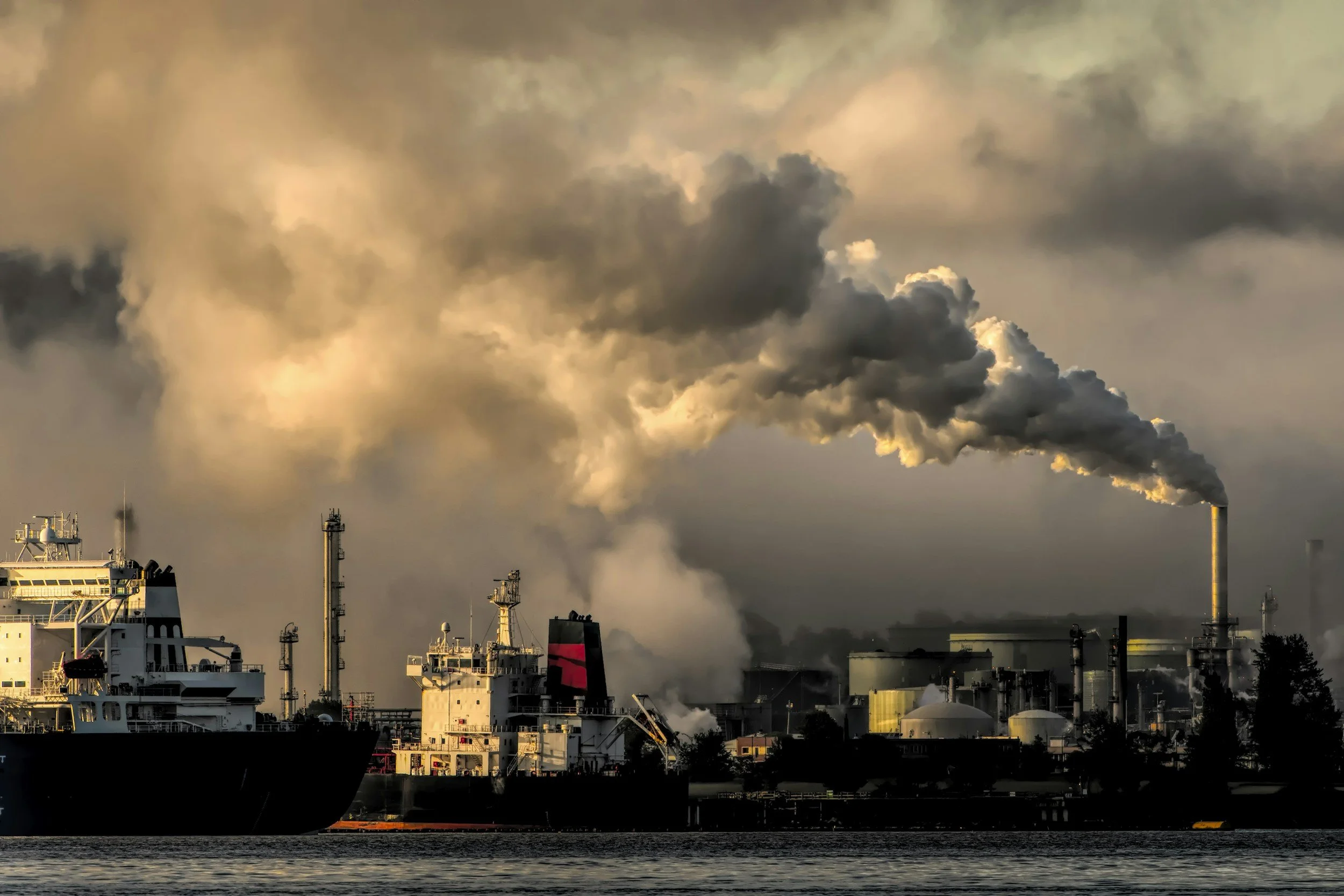
The burning of fossil fuels is the largest contributor to the enhanced greenhouse effect. Fossil fuels include coal, oil and natural gas. They are burned in power stations, factories, industries, homes and transport systems.
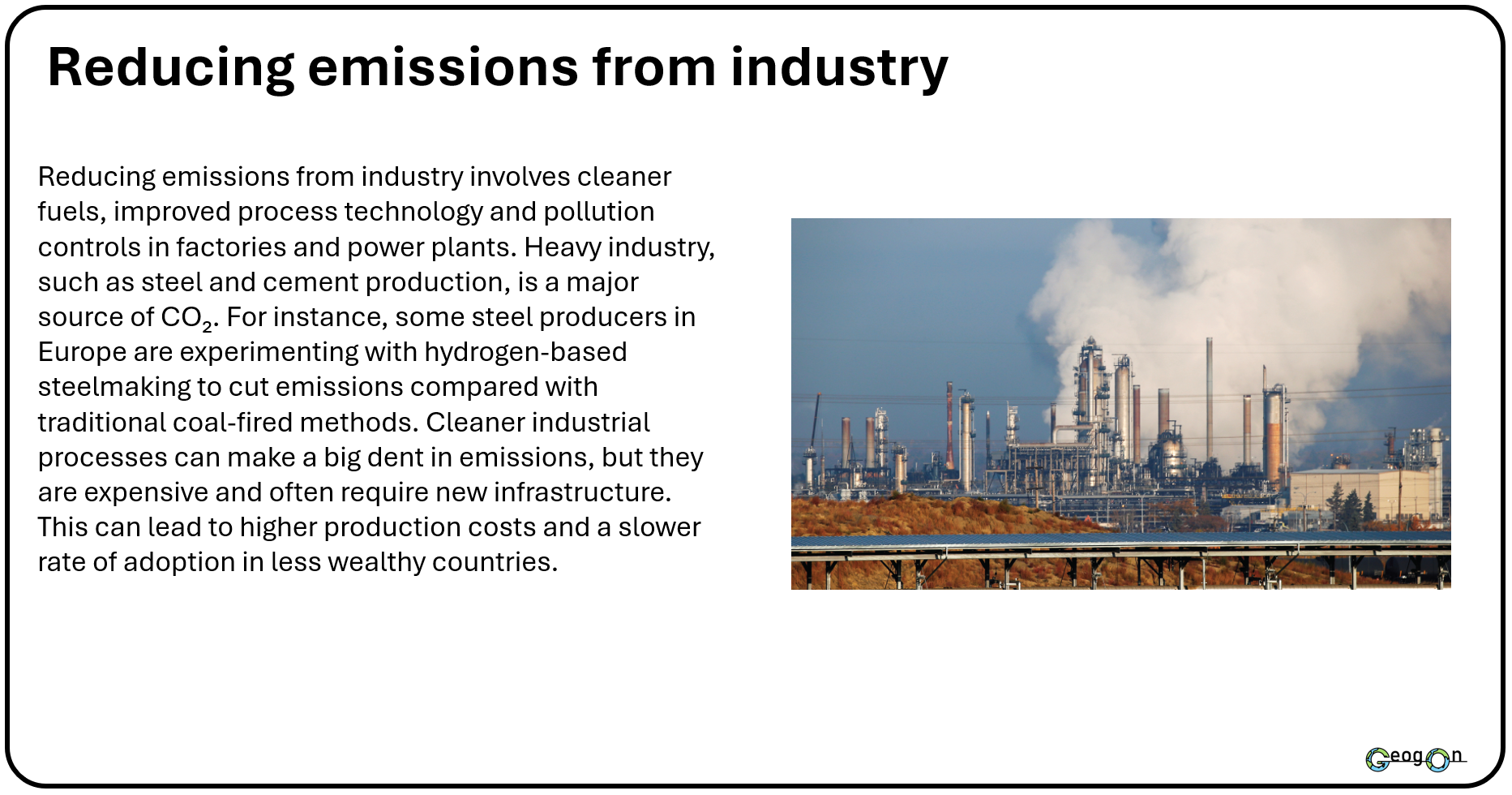
Coal, oil and gas-fired power stations burn fossil fuels to generate electricity. Industries and factories use fossil fuels for manufacturing and industrialisation. Cars, lorries, ships and aircraft also burn fuels, releasing carbon dioxide directly into the atmosphere.
This adds extra carbon dioxide (CO₂) to the atmosphere. Carbon dioxide is a greenhouse gas, so higher concentrations of CO₂ trap more long-wave radiation. This strengthens the greenhouse effect and increases global temperatures.
Agriculture
Agriculture strengthens the enhanced greenhouse effect mainly by releasing methane (CH₄) and nitrous oxide (N₂O).
Livestock, especially cattle, produce methane during digestion. This methane is released into the atmosphere. Rice farming also produces methane because flooded rice fields create low-oxygen conditions, allowing organic matter to decompose and release methane.
Fertilisers can also release nitrous oxide from soils. Nitrous oxide is a powerful greenhouse gas, even though it is found in smaller amounts than carbon dioxide.
Methane is especially important because it traps heat very effectively in the atmosphere. This means agriculture can make a significant contribution to the enhanced greenhouse effect, particularly through cattle farming and rice production.
Deforestation
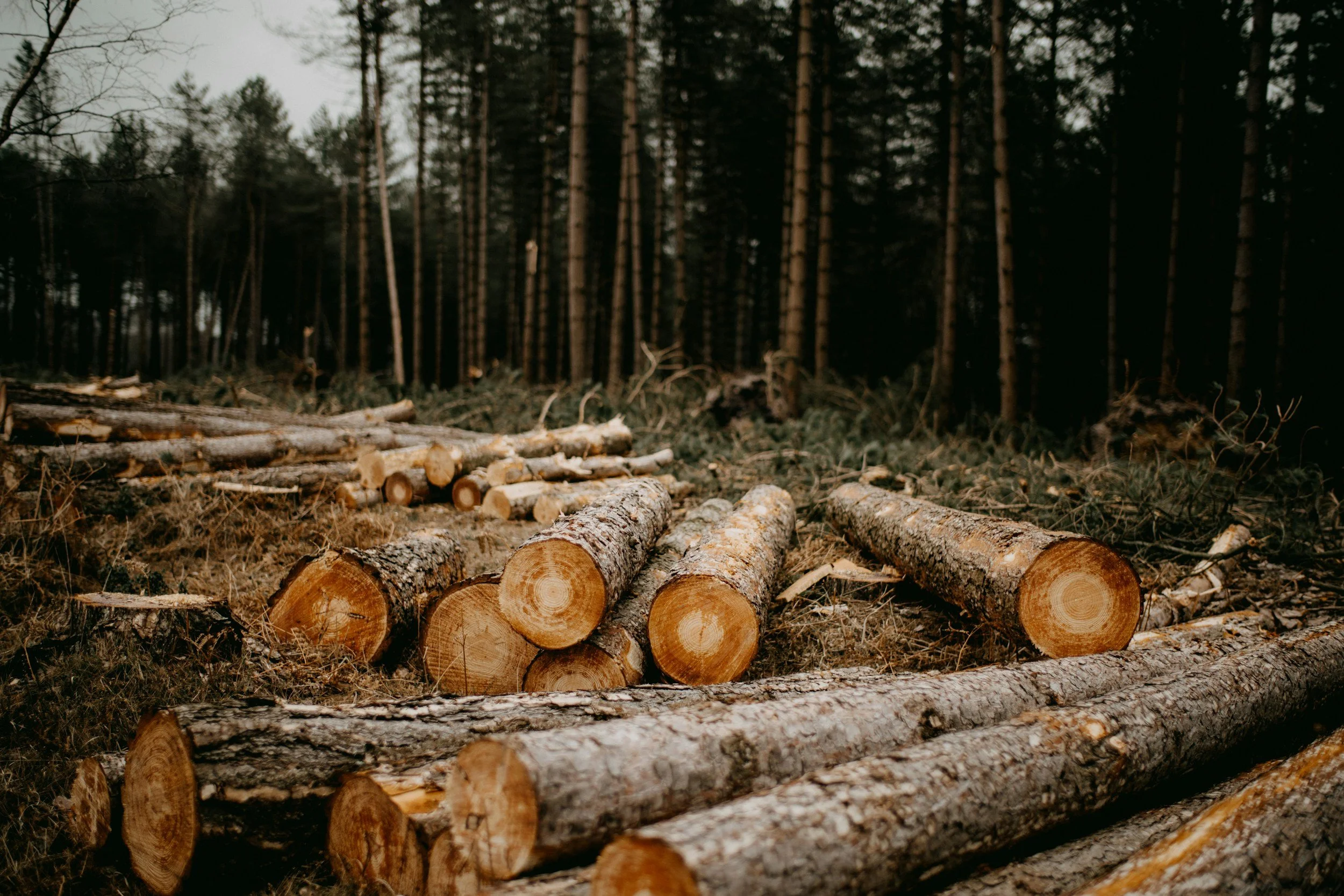
Deforestation means the removal of trees and forests. It contributes to the enhanced greenhouse effect in two main ways.
Firstly, trees remove carbon dioxide from the atmosphere through photosynthesis. When forests are cut down, there are fewer trees to absorb CO₂. This means more carbon dioxide remains in the atmosphere.
Secondly, trees store carbon in their trunks, branches, roots and leaves. When trees are burned in forest fires, or cleared to make space for farming, this stored carbon is released back into the atmosphere as carbon dioxide.
Deforestation is therefore a problem because it both reduces carbon absorption and increases carbon emissions.
5.2 The impacts of climate change at a range of geographic scales
Climate change affects places at different scales. This means it can affect small places, large areas, or the whole world.
Local scale means one small place, such as a town, city or village.
Example: a coastal town may flood more often because sea levels are rising.
National scale means one whole country.
Example: a country may have more droughts, floods or food shortages.
Regional scale means a large area with several countries.
Example: parts of Africa may become hotter and drier.
Global scale means the whole world.
Example: average global temperatures are rising, ice is melting, and sea levels are increasing.
Climate change is a global problem, but different places are affected in different ways.
Primary and secondary impacts
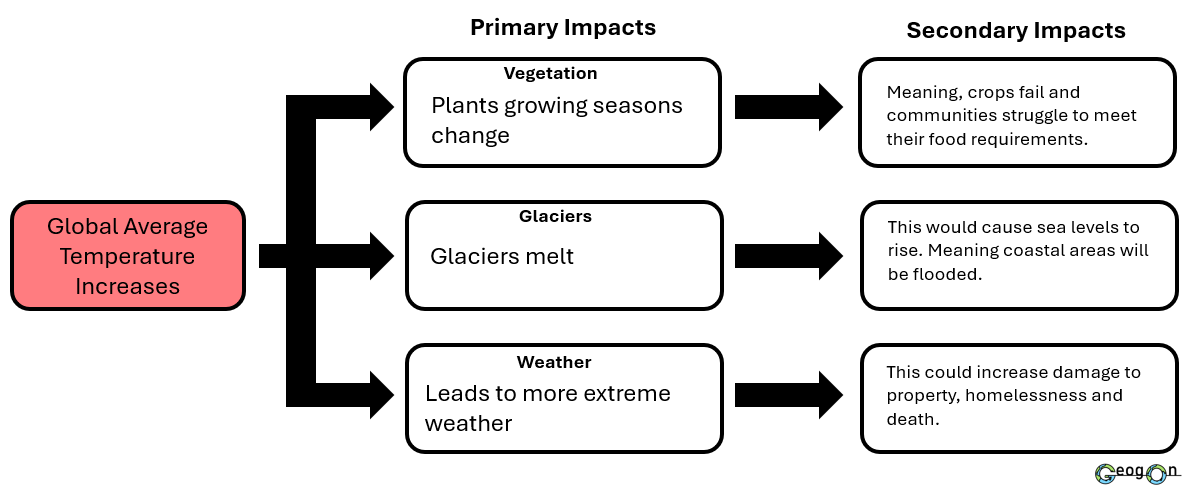
A primary impact is a direct result of climate change.
Examples include:
higher temperatures
melting ice
rising sea levels
more heatwaves
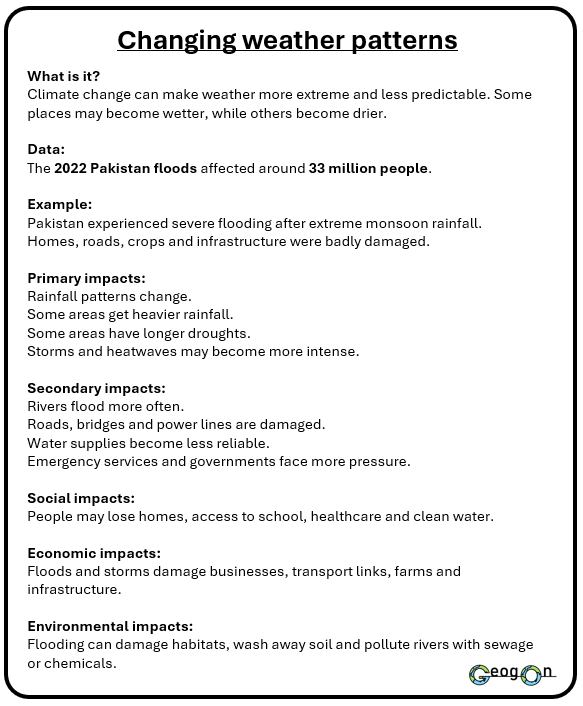
changing rainfall patterns
A secondary impact happens because of a primary impact.
For example, higher temperatures can melt glaciers and ice sheets. This causes sea levels to rise. Rising sea levels can then cause coastal flooding, damage homes, destroy farmland and force people to move away.
Short-term impacts
Short-term impacts are happening now or may happen soon.
Examples include:
Heatwaves, which can make people ill.
Heavy rainfall and storms, which can cause flooding.
Droughts, which reduce water supplies.
Wildfires, which can destroy homes, farms and habitats.
Lower crop yields, which can increase food prices.
These impacts are easy to see because they affect people’s daily lives.
Impacts of Climate Change

5.2.1 Present day and future impacts of climate change

Long-term impacts
Long-term impacts happen over many years or decades. They can be more serious because they may be difficult to reverse.
Examples include:
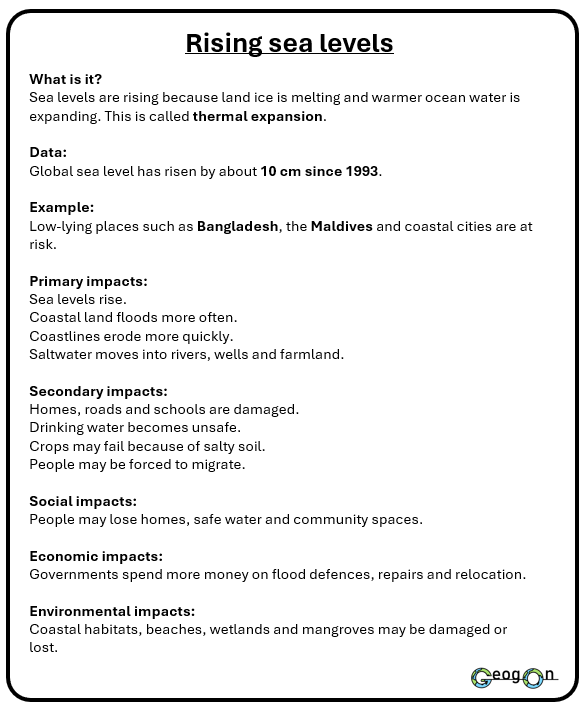
Rising sea levels, caused by melting land ice and warmer ocean water expanding.
Loss of coastal land, especially in low-lying areas.
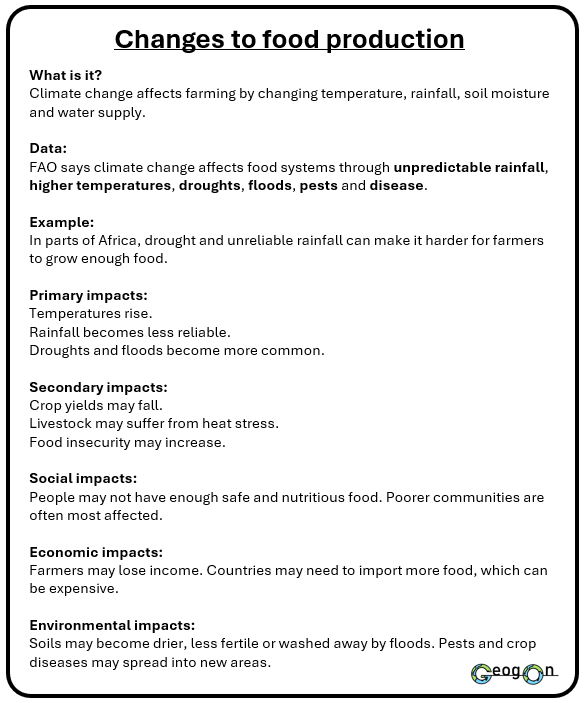
Less reliable food production, especially in places that become hotter or drier.
Loss of biodiversity, as some plants and animals cannot adapt.
More migration, as people move away from areas affected by flooding, drought or food shortages.
Higher costs for governments, as countries spend more on flood defences, healthcare, food imports and disaster recovery.
Future predictions for climate change impacts
Climate change impacts are expected to become more serious in the future, especially if greenhouse gas emissions remain high. Scientists use climate models to predict possible changes by 2050 and 2100, but the exact impacts will depend on how quickly people reduce emissions.
Sea levels are predicted to continue rising because glaciers and ice sheets will keep melting, and warmer ocean water will continue to expand. This will increase the risk of coastal flooding, erosion and saltwater entering freshwater supplies. Low-lying countries, small islands and coastal cities are likely to be most at risk.
Global temperatures are also expected to rise further. This could make heatwaves more frequent and intense, especially in cities where concrete and tarmac store heat. Higher temperatures may increase heat-related illness, water shortages, demand for air conditioning and pressure on electricity supplies.
Weather patterns are predicted to become more extreme and less reliable. Some places may experience heavier rainfall and flooding, while others may face longer droughts. Storms may also become more damaging in some regions, leading to greater disruption to homes, transport, farming and infrastructure.
Food production may become less reliable in many parts of the world. Higher temperatures, droughts, floods, pests and changing rainfall patterns can reduce crop yields and increase food prices. Poorer countries that depend heavily on farming are likely to be most vulnerable to food insecurity.
Overall, future climate change is expected to increase risks to people, economies and environments. The impacts will not be the same everywhere, but poorer and more exposed communities are likely to be affected most severely.
5.3 Responses to climate change
Responses to climate change are the actions people, governments and organisations take to reduce climate change or deal with its impacts.
There are two main types of response: mitigation and adaptation.
Responses can also be categorised into short and long term responses.
Short-term responses are actions that help people deal with climate risks quickly.
Long-term responses are planned over many years. They try to reduce future risks or prepare places for future climate change.
Mitigation
Mitigation means reducing the causes of climate change. It focuses on cutting greenhouse gas emissions or removing carbon dioxide from the atmosphere.
Examples include:
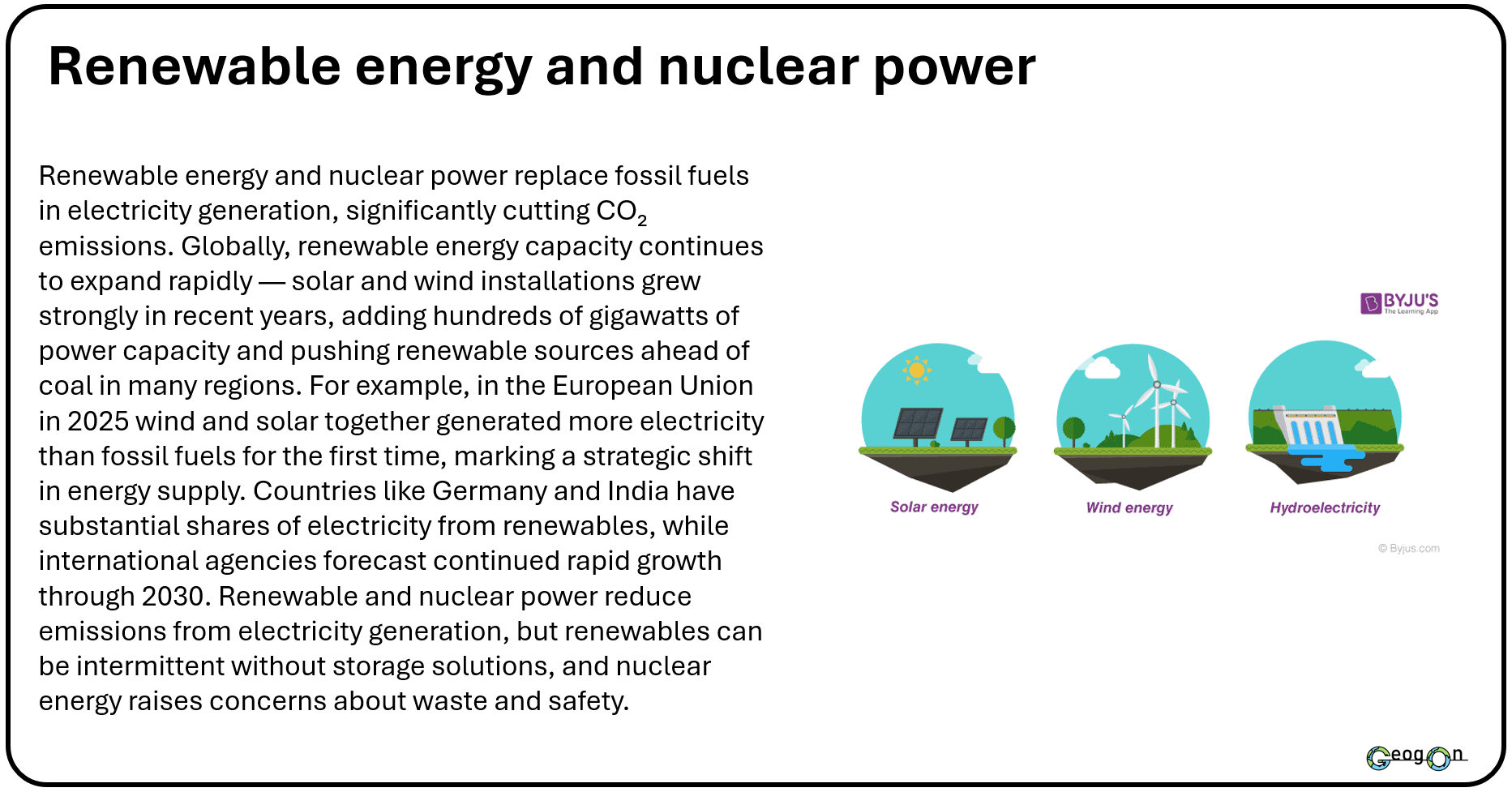
using renewable energy, such as solar, wind and hydroelectric power
improving energy efficiency in homes, schools and businesses
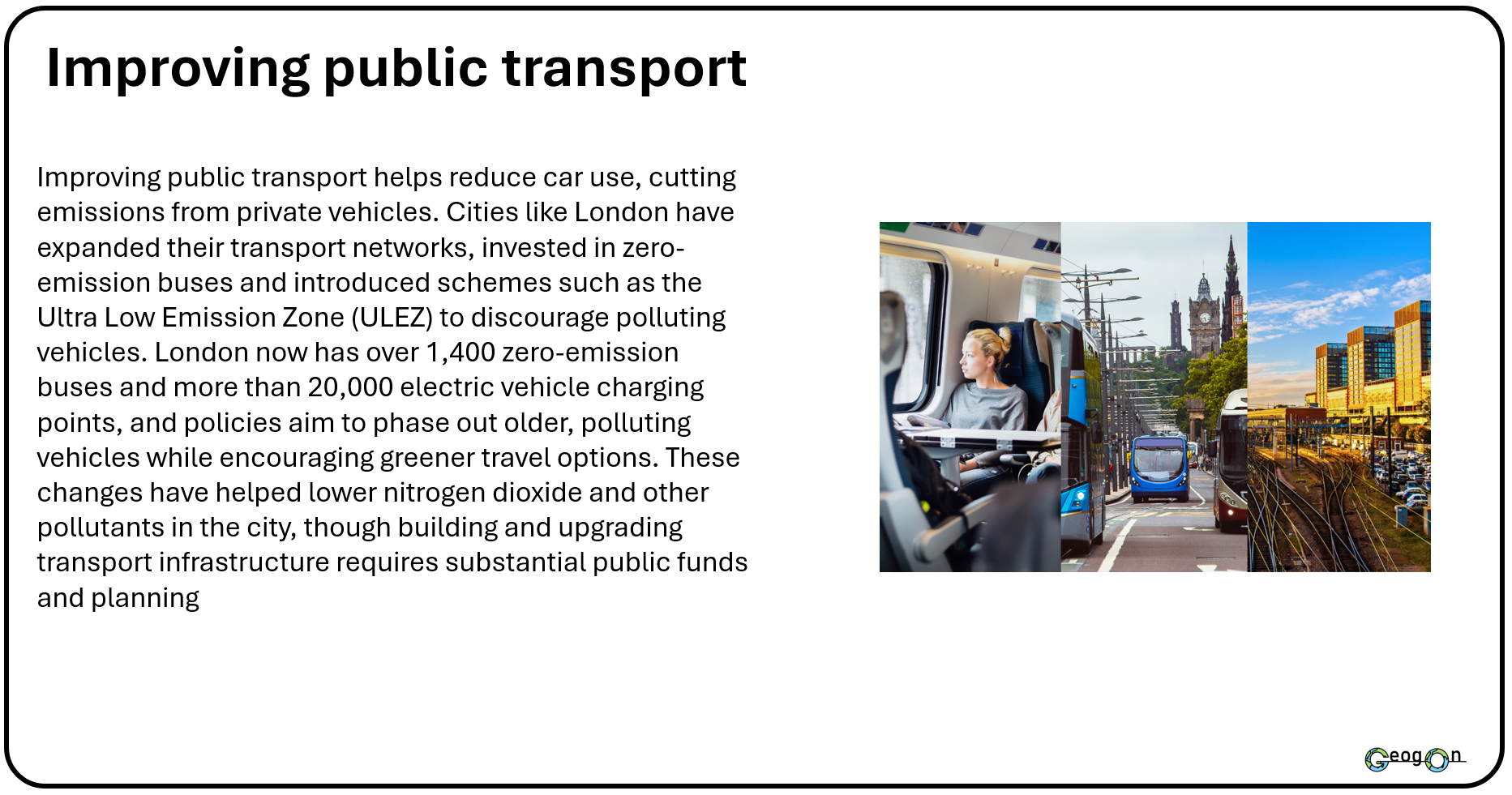
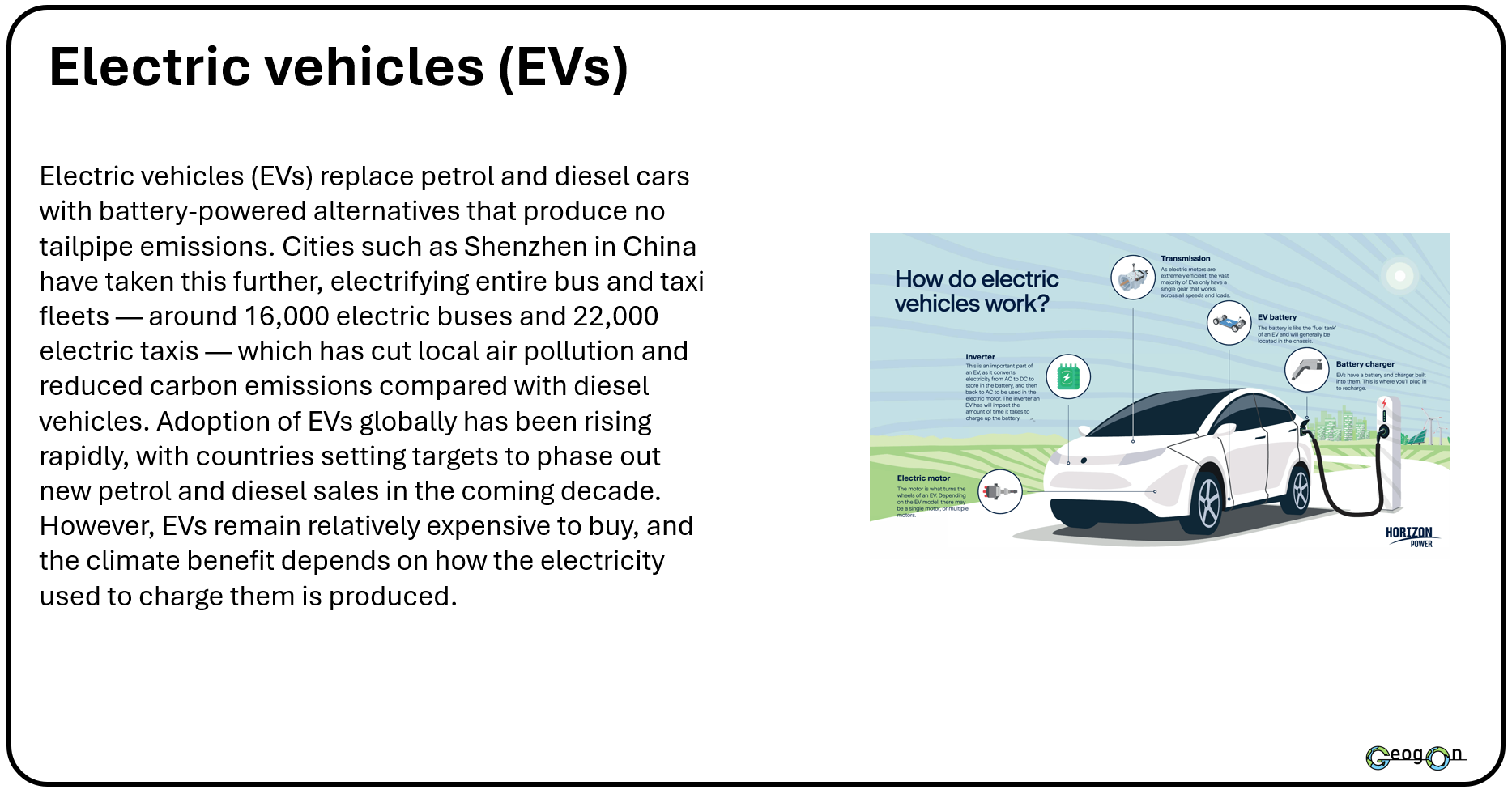
using public transport, cycling and electric vehicles
planting trees and protecting forests
reducing waste and recycling more
using carbon taxes or emissions trading schemes
Mitigation is important because it tries to slow down future climate change.
Example sentence: Renewable energy is a mitigation strategy because it reduces the need to burn fossil fuels, lowering carbon dioxide emissions.
National strategies
National strategies are actions taken by one country.
Governments can reduce emissions by investing in renewable energy, setting rules for factories, improving public transport and encouraging electric vehicles. They can also protect forests, plant trees and improve energy efficiency in buildings.
Governments can also help people adapt. For example, they may build flood defences, improve water storage, protect coastlines, support farmers during droughts and create heatwave warning systems.
Example: A country may build sea walls in coastal cities to reduce flood risk, while also investing in solar and wind power to reduce fossil fuel use.
Adaptation
Adaptation means changing how people live, work and build so they can cope with the impacts of climate change.
Examples include:
building sea walls and flood barriers
improving flood warning systems
growing drought-resistant crops
storing more water in reservoirs
designing buildings that stay cooler during heatwaves
planting trees in cities to reduce heat
moving people away from high-risk coastal areas
Adaptation is important because some climate change impacts are already happening.
Example sentence: Building sea walls is an adaptation strategy because it helps protect coastal areas from rising sea levels and flooding.
International agreements
Climate change is a global problem, so countries need to work together.
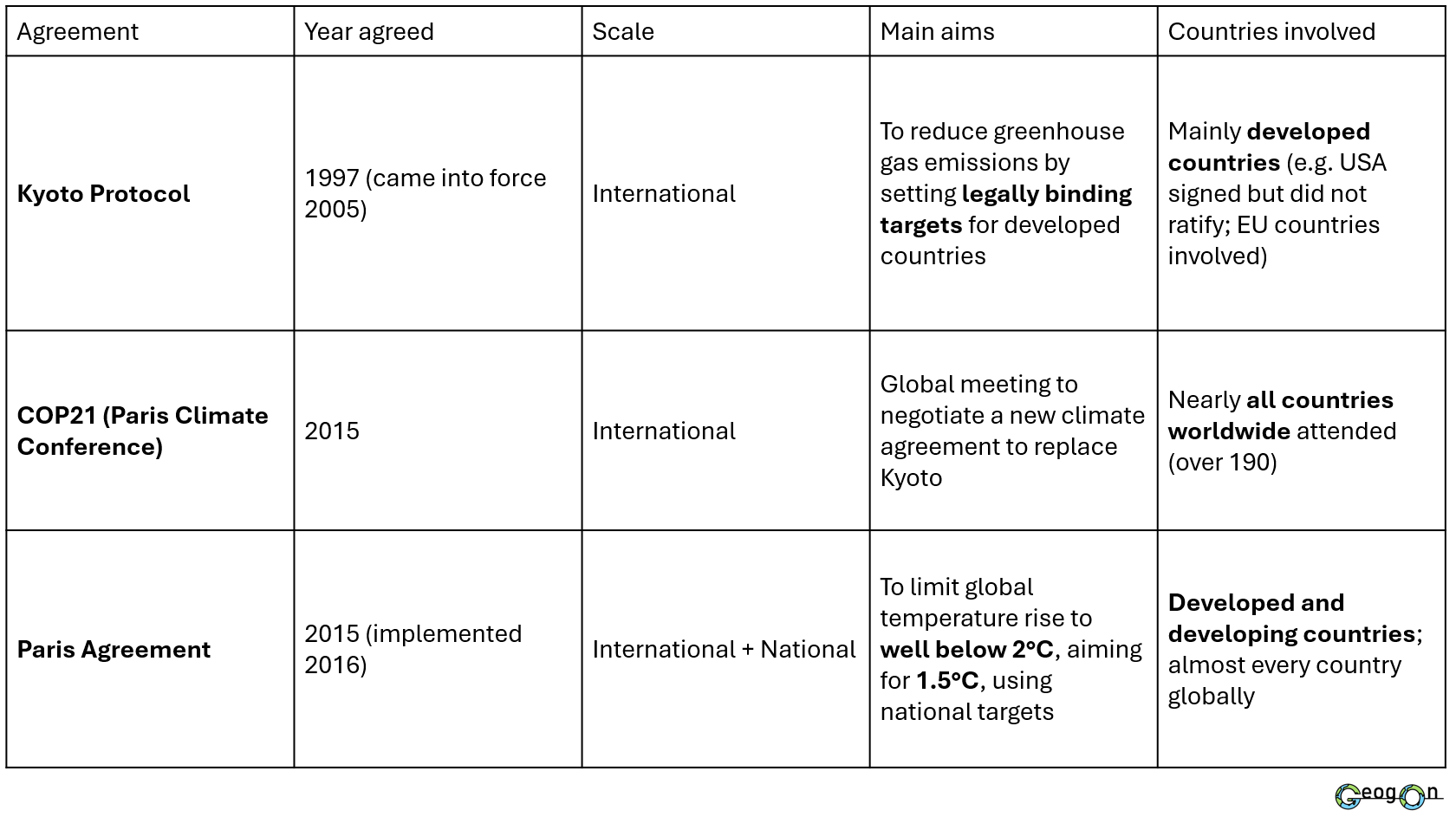
The Paris Agreement is the main international agreement on climate change. Countries agree to reduce greenhouse gas emissions and try to limit global warming. Each country creates a plan called a Nationally Determined Contribution, or NDC, which explains how it will reduce emissions and adapt to climate change.
The Kyoto Protocol was an earlier international agreement. It set legally binding targets for some developed countries to reduce greenhouse gas emissions.
International agreements are important because no country can solve climate change alone. However, they can be difficult because countries may disagree about money, responsibility and how quickly emissions should be reduced.
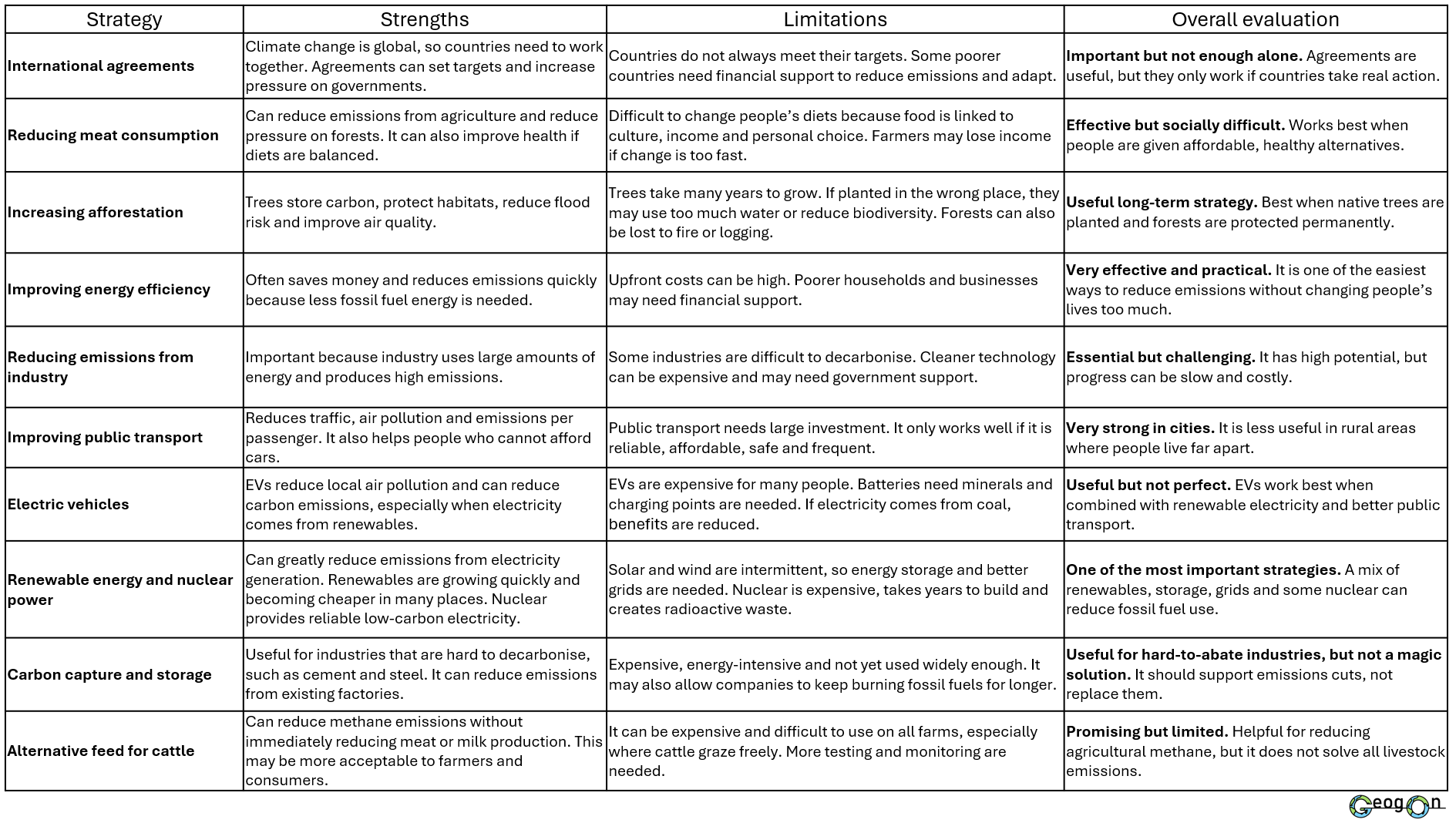
Strategies and techniques for managing Climate change
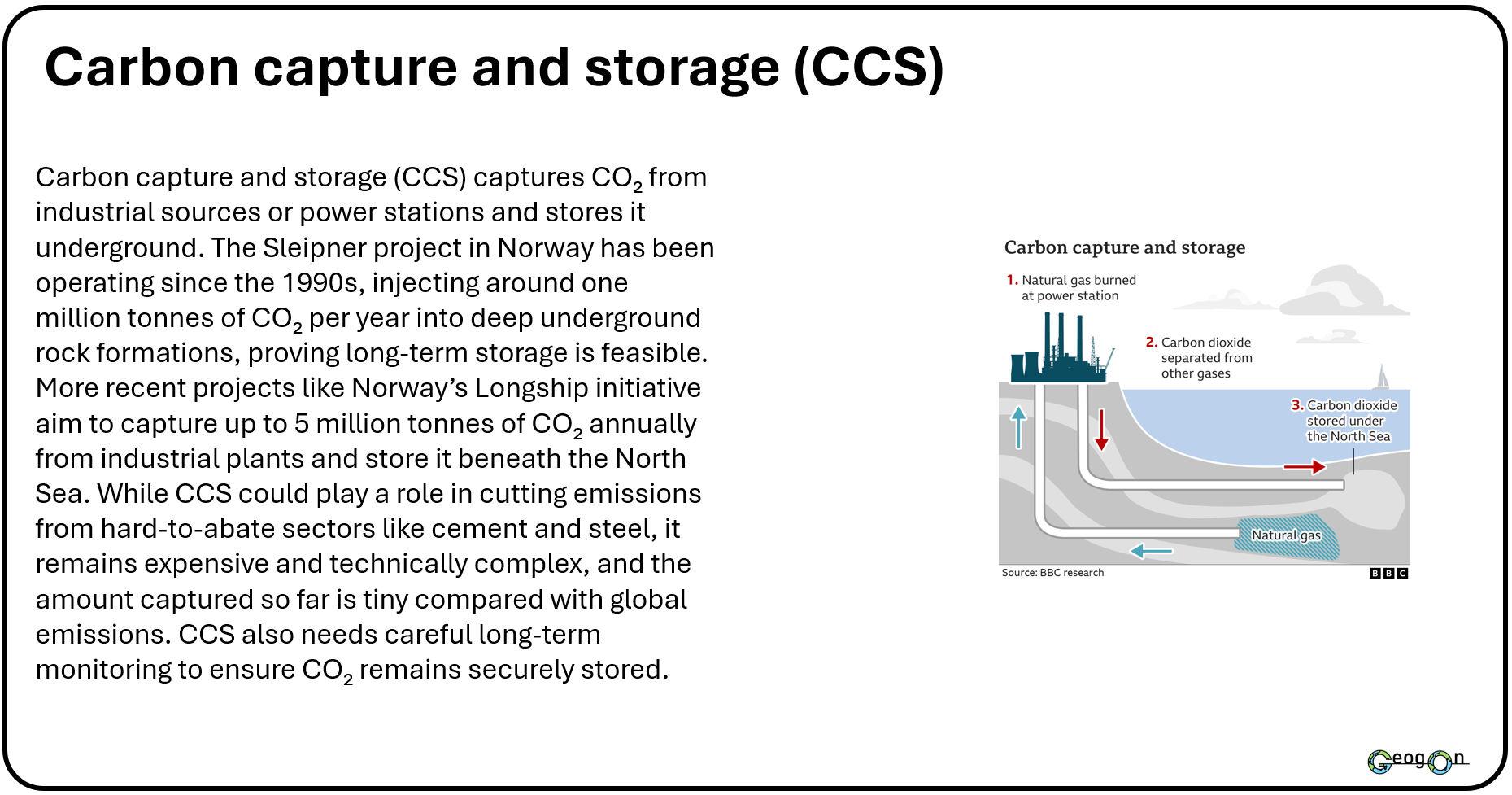
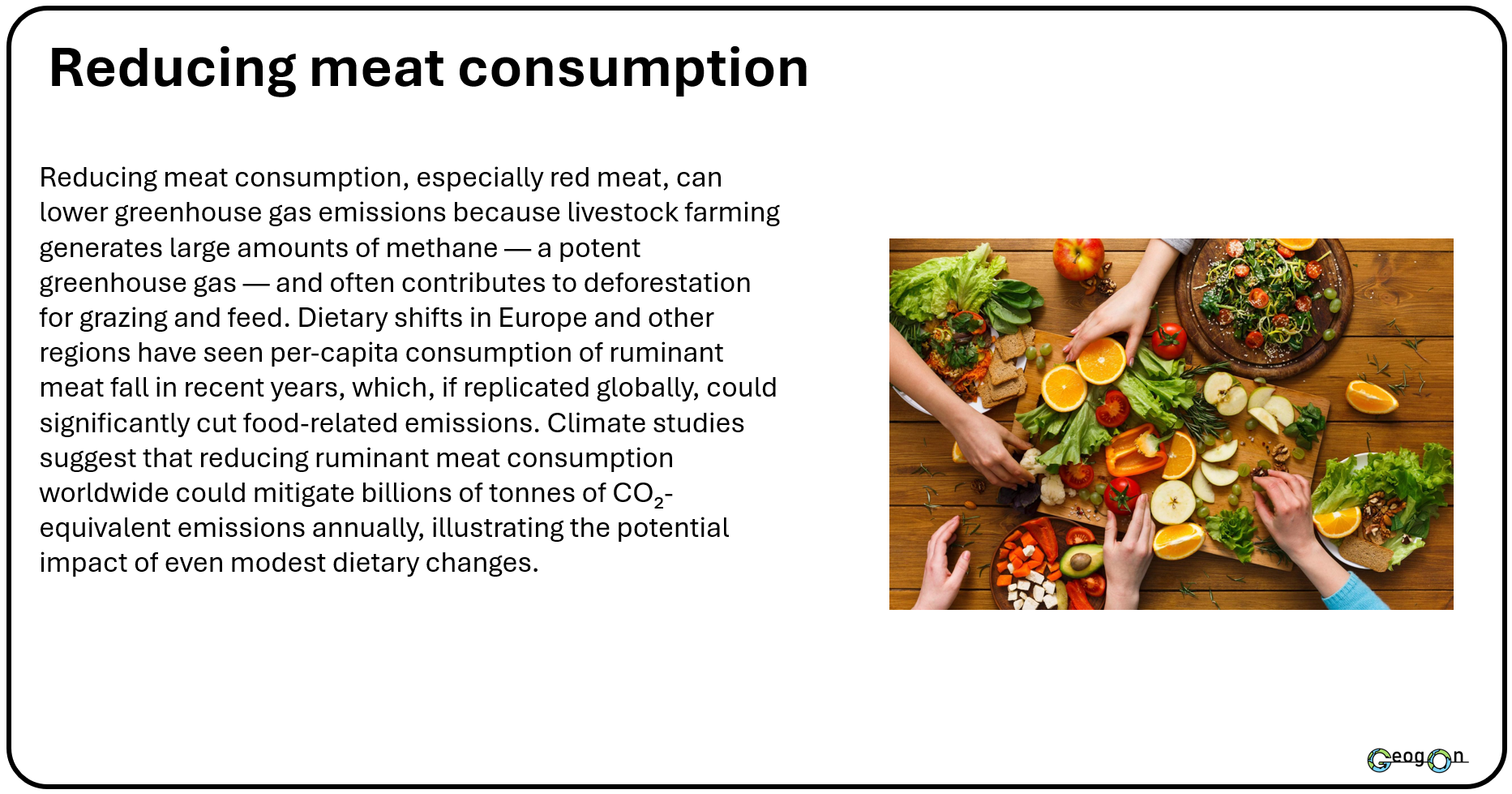
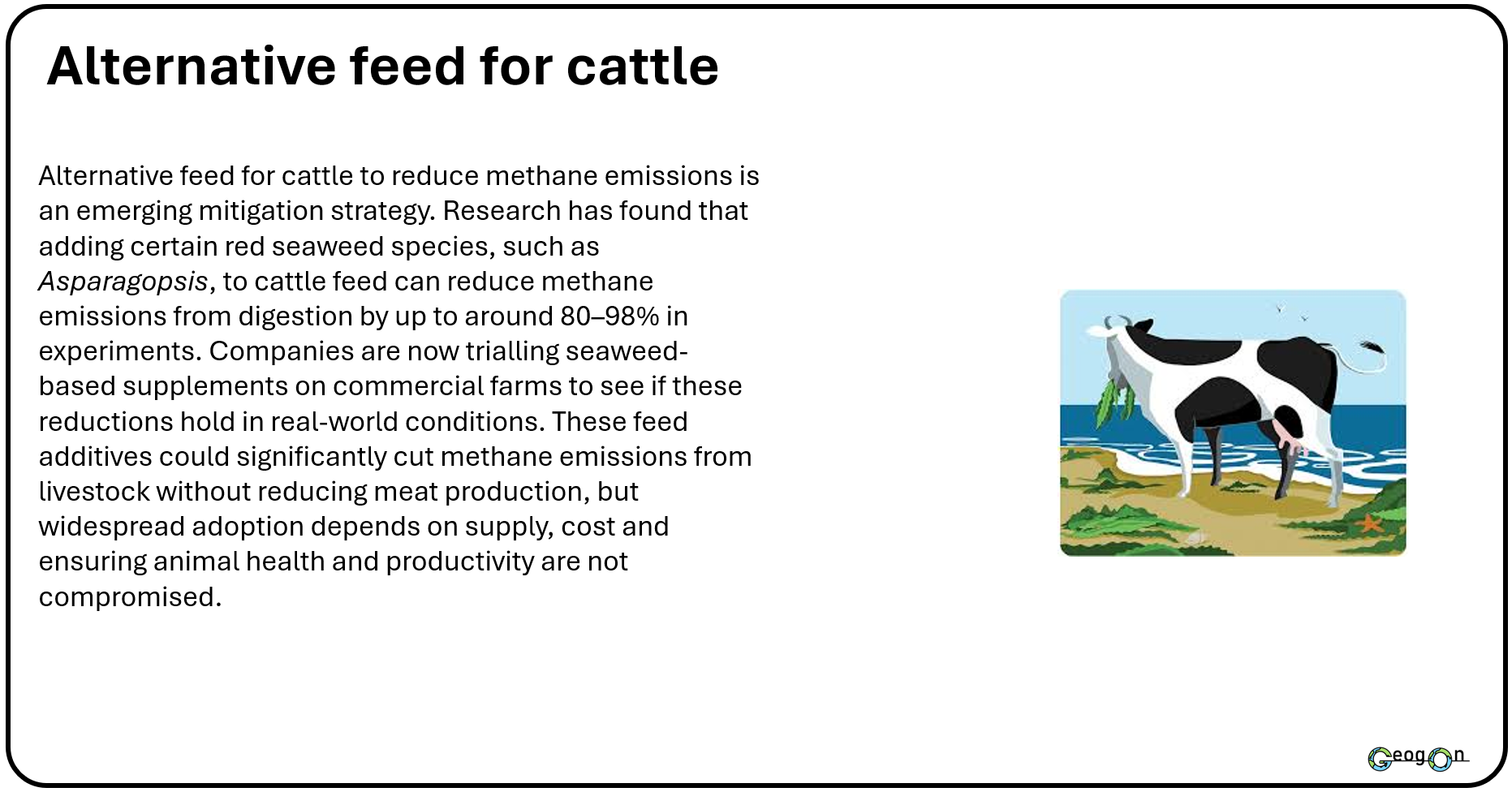
Evaluation of climate change mitigation strategies
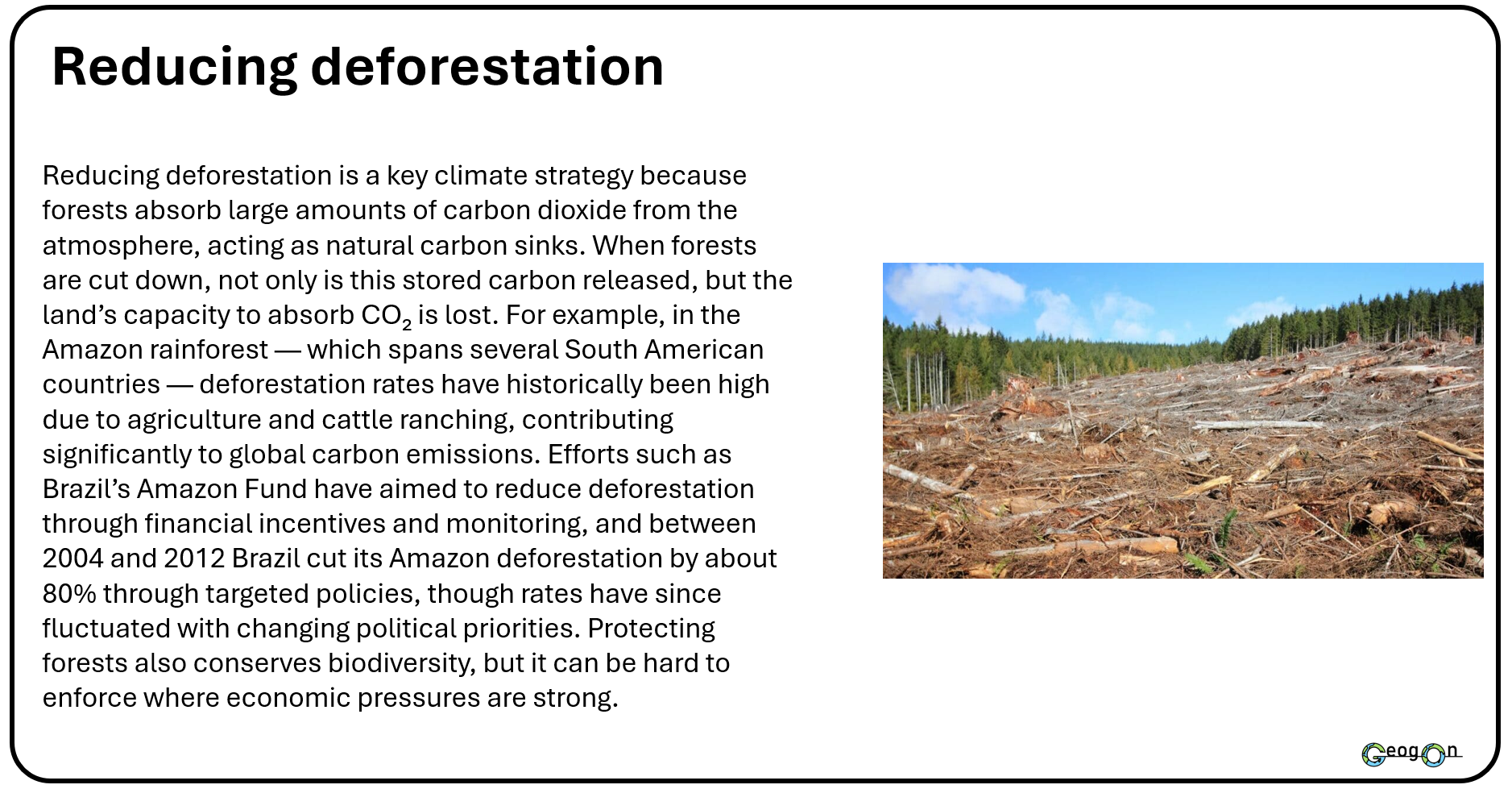
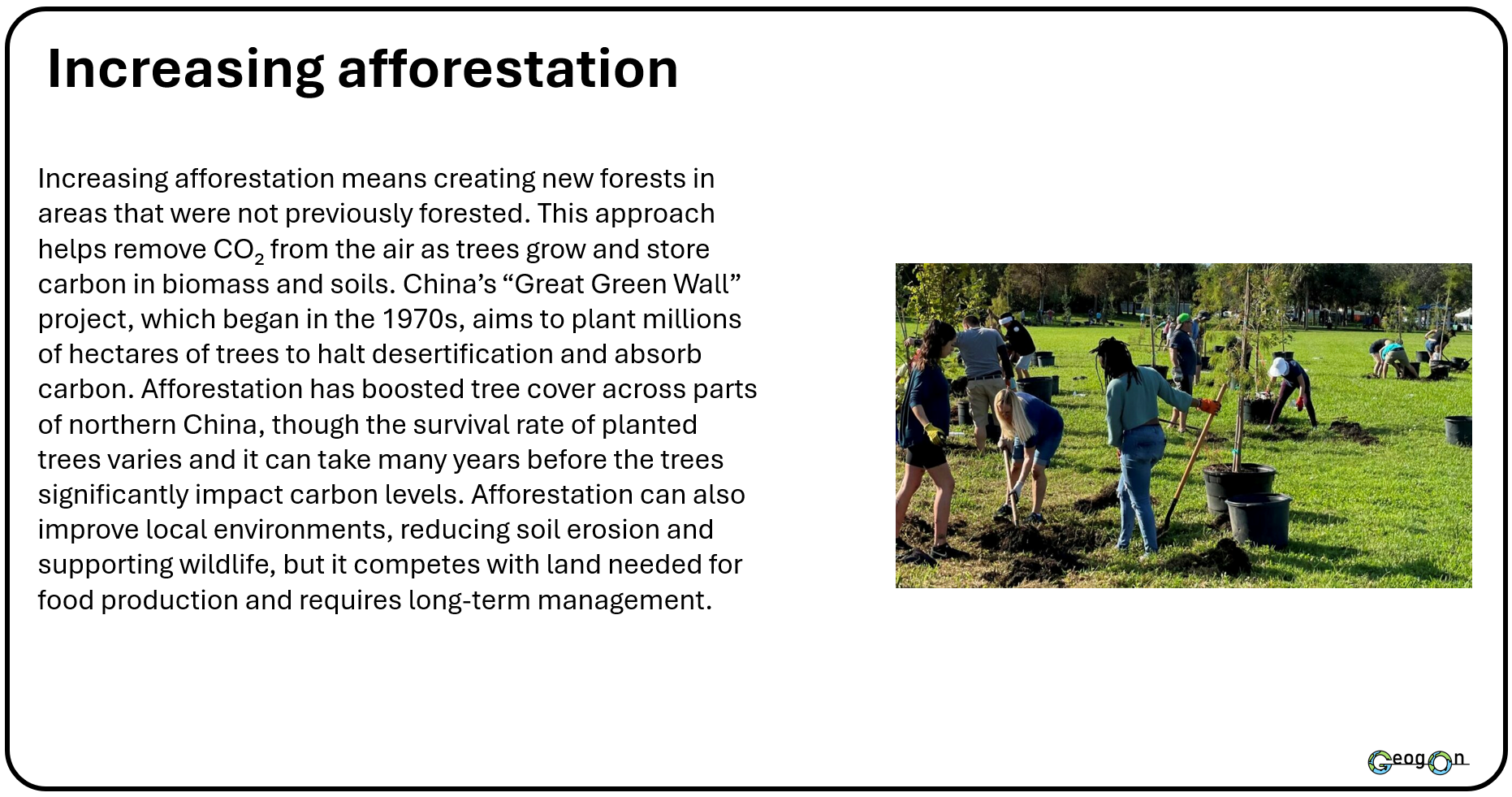
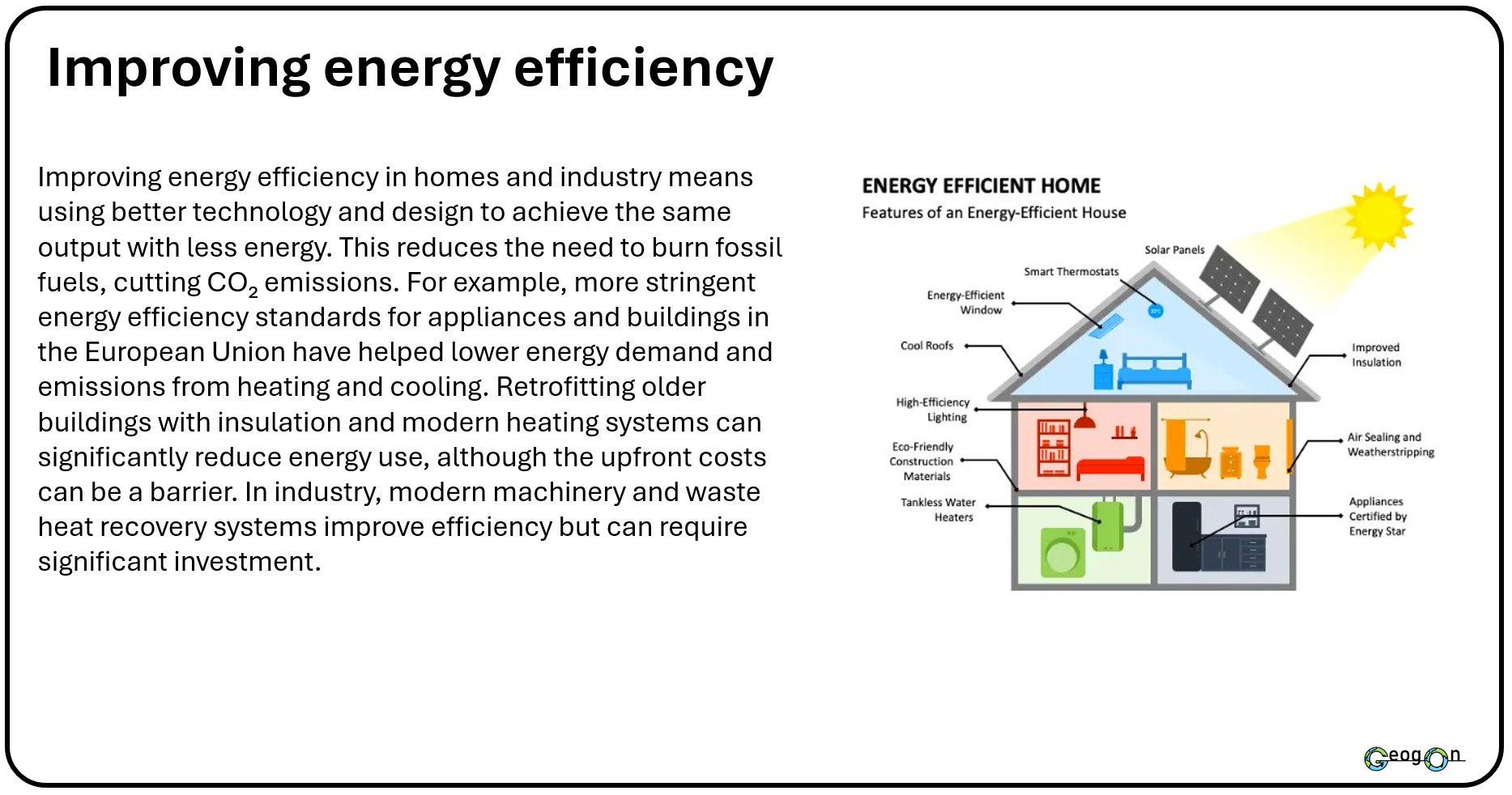
No single strategy can manage climate change on its own. The strongest approach is to use several strategies together. For example, renewable energy, energy efficiency and public transport can reduce fossil fuel use, while diet change, afforestation and alternative cattle feed can reduce emissions from land use and agriculture.
The most effective strategies are usually those that reduce emissions at a large scale and can be used for a long time. However, the success of each strategy depends on cost, technology, public support and government action.